
Chapter 6: Understanding Variance in Spin
This chapter is the logical continuation of the previous one, where we began exploring the concept of variance.

Gandalf
Professional Spin & Go player, co-founder of Poker Sciences

Variance is probably a Spin player's worst enemy
Following the previous chapter, you're probably asking yourself the following question (and if so, you're absolutely right):
Ok, I'm willing to believe it's possible to win in Spin, and I understand that short-term results don't mean much.
But concretely, how many games do you need to play to be sure of winning?
To answer this, we're going to run some simulations.
For this, we're going to use the Swongsim software again. I don't think this surprises you anymore.
We're going to simulate the bankroll of 100 good regular Spin players with a €1 buy-in (CEV = 65, which is easily achievable at the €1 level).
We'll simulate series of 200 games, then 1,000 games, and finally 10,000 games to observe the impact of variance.
100 players who each play 200 games
Here's what we get:
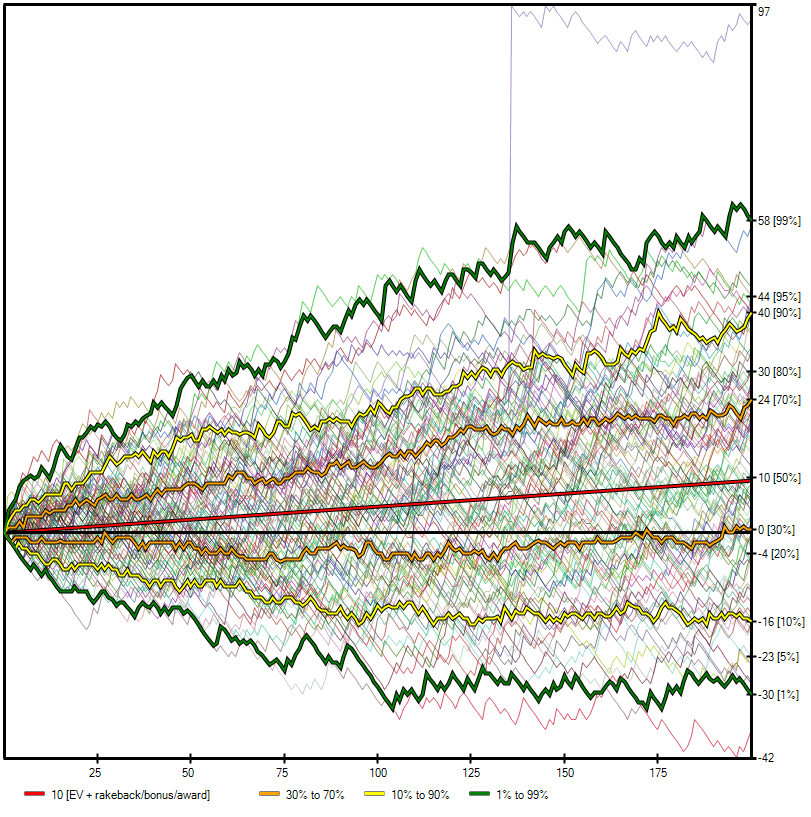
Here's the result of the simulation — it looks a bit terrible as usual with Swongsim, but I'll explain it simply.
This simulation gives us the following information:
30% of players lost money after 200 games.
The unluckiest 5% have losses of more than 20 buy-ins, while the luckiest 5% can reach gains of over 40 buy-ins.
On average (well, technically it's a "median" but you get the idea), players win 10 buy-ins.
So to answer our initial question:
Are 200 games enough to be sure of winning money in Spin with a CEV of 65? NO.
100 players who each play 1,000 games
Here's what we get this time with a higher volume of play per player:

This new simulation gives us the following information:
Here, 10% of players are still at a loss. That's not many, but enough for many players to start questioning themselves.
The luckiest ones accumulate over 120 buy-ins.
The average run is at about 50 buy-ins of profit.
So to answer our initial question:
Are 1,000 games enough to be sure of winning money in Spin with a CEV of 65? NO.
100 players who each play 10,000 games
Here's the final simulation:
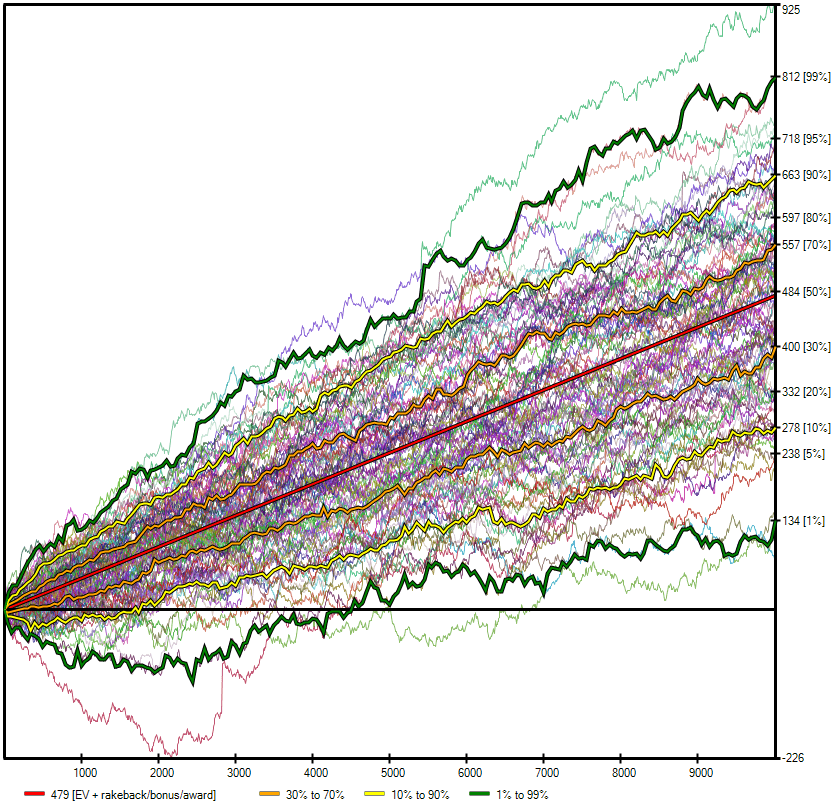
This time we're good. All players are in the positive.
There's a 90% chance of being between +238 buy-ins and +718 buy-ins.
A thought for the player who starts their first 2,000 games with a loss of 226 buy-ins... (pink curve at the very bottom of the image). Remember, this is a good player. They just didn't get lucky.
So to answer our initial question:
Are 10,000 games enough to be sure of winning money in Spin with a CEV of 65? YES. But note that there can still be huge differences in buy-ins between theoretical and actual gains.

In conclusion: I don't think this will surprise you, a high volume of play is essential to beat variance in Spin.
Summary
In the short term, variance can distort your judgment... Even the best players can go through losing periods, especially with a sample of 200 or 1,000 games. Over larger volumes (10,000 games), variance fades significantly, but there can still be major differences in winnings between good players.