The Run Luck Badge: quantify your luck
Understand what the Run Luck badge measures, how to read it, and what it does not replace in your diagnosis.

Gandalf
Co-founder of Poker Sciences
Every Spin player ends up asking the same question sooner or later, especially after a streak of lost or won flips.
Am I lucky or unlucky?
Poker Spin Tracker answers that question with a visual, quantified indicator: the Run Luck Badge, shown right next to your chips and bankroll curves.
This chapter explains what it measures, how to read it, and also what it does not measure.
1. What the badge measures
Across your whole displayed sample, the badge compares the gap between your actual winnings and their expected value (EV).
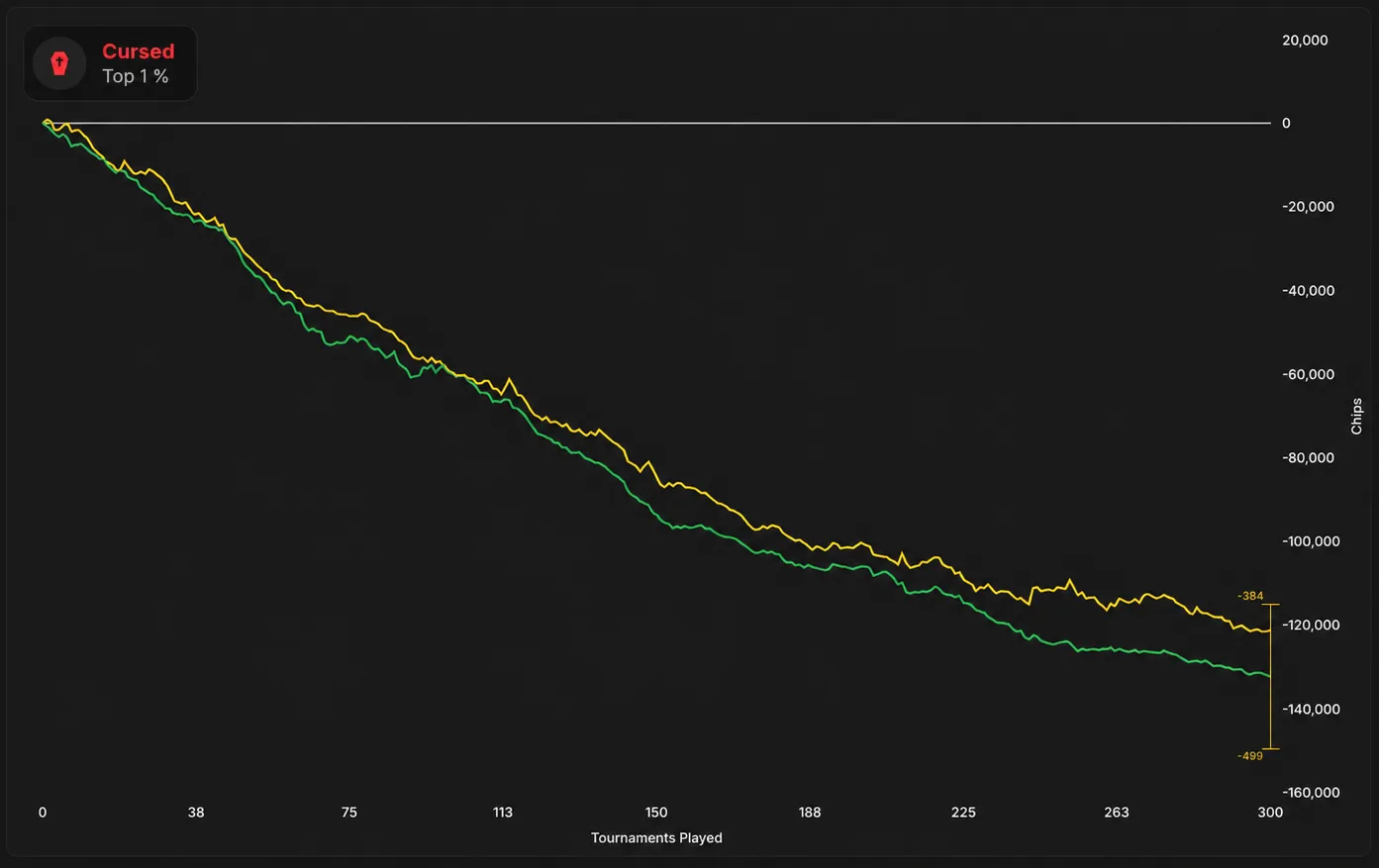
Chips tab: the gap between your chips actually won and your EV (chips).
Bankroll tab: the gap between your Profit and your Effective EV Profit.
The badge then turns that gap into a percentile. It reads the same way in both tabs, but the calculation differs, because the two gaps are not the same kind of thing.
Chips tab: the gap is compared to the dispersion observed on your own sample. What a tournament pays in chips is bounded (you can never win more than the stacks in play), so your sample is enough to measure its variance.
Bankroll tab: the gap is compared to your room's prize distribution, multipliers included. A x1000 cannot be measured off your sample (on its own it pays more than hundreds of ordinary tournaments), but the tracker knows exactly how often it comes up.
No need to go any further into the maths: the percentile reads very intuitively. Picture 100 virtual players who played the exact same volume as you, in the same room and at the same buy-ins. Then ask yourself:
How many of them would show a gap this big between the two curves (actual winnings vs expected winnings)?
The percentile gives you the answer. A Top 5% on the lucky side means that only 5 players out of 100 would have run as lucky as you, or luckier. On the negative side, the logic is symmetrical.
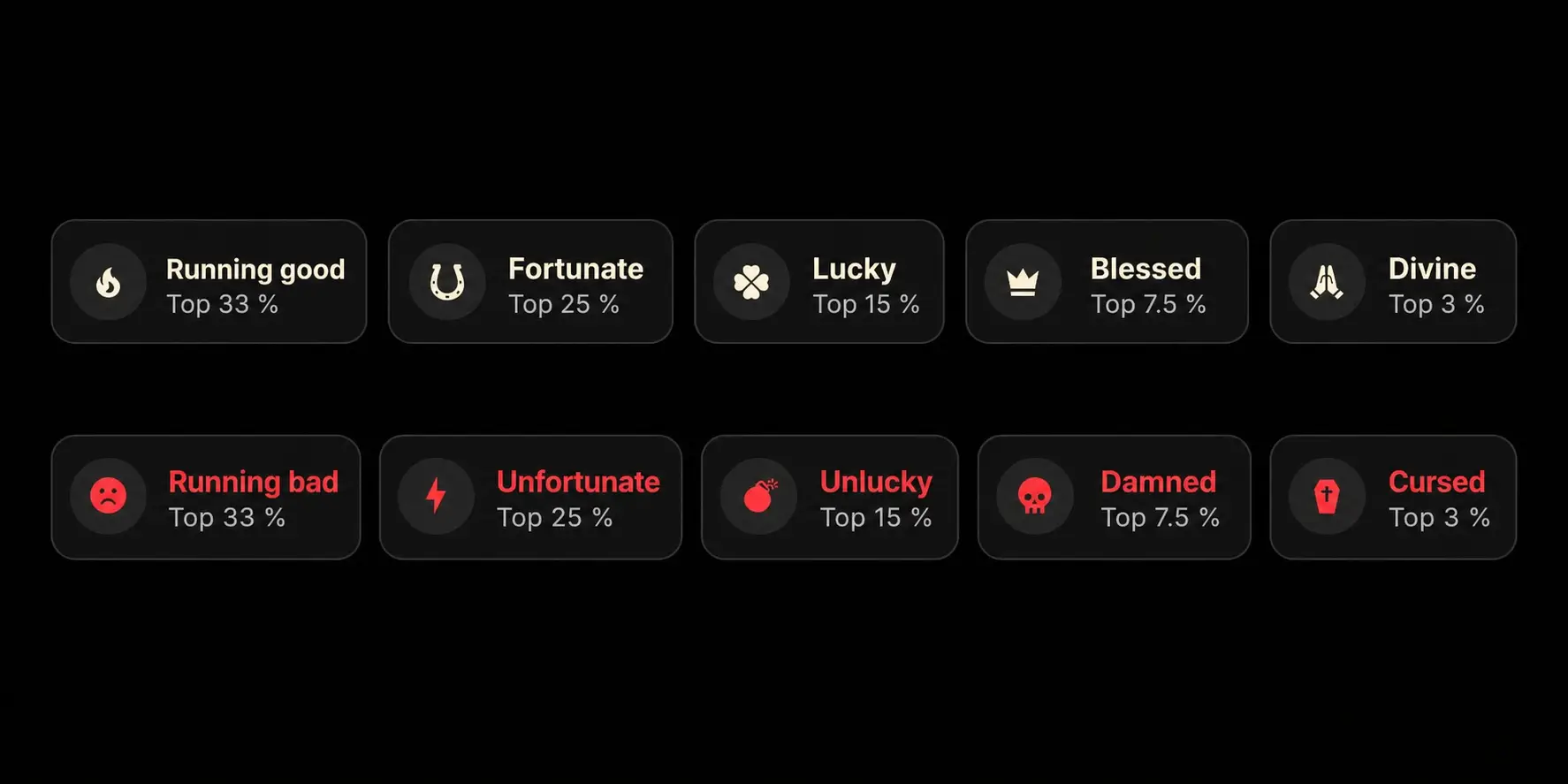
Here are the different badges, depending on the percentile:
| Luck | Bad luck | Threshold |
|---|---|---|
| Divine | Cursed | Top 3% |
| Blessed | Damned | Top 7.5% |
| Lucky | Unlucky | Top 15% |
| Fortunate | Unfortunate | Top 25% |
| Running good | Running bad | Top 33% |
On the Bankroll side, jackpots put extreme values within reach: hitting a x1000 over a few hundred tournaments is a run with one chance in several hundred thousand. The badge then shows a Top far below 1 %, and settles for "Top < 0.0001 %" past one chance in a million.
The badge only appears from 50 games onwards. Below that, the measure is too unstable: a Divine or a Cursed over 20 games means nothing, and showing a badge would be misleading.
2. What it covers (and what it does not)
In the Chips tab, the badge measures all-in luck: the gap between your chips actually won and your EV (chips).
In the Bankroll tab, it measures two things at once: that same all-in luck, plus the multiplier lottery (the gap between your Profit and your Effective EV Profit). And the second one dominates by far: a single x1000 weighs more than thousands of flips.
It does not cover the three other residual variances from chapter 4.1:
- The cards you are dealt (the luck of picking up good hands, or not, over the volume you played)
- The opponent ranges at showdown (getting called by a favorable or an unfavorable range)
- The spots that do not go all-in (3bet fold, river call, bluff)
A Running bad badge means you lost more flips than expected, and on the Bankroll side that the multipliers did not land the way your volume gave you reason to hope. That's it.
It is entirely possible that on top of that you had, say, a brutal "card drought". The Run Luck Badge does not take it into account.

3. The badge does not tell you whether you play well
Of course, the Run Luck Badge is not a skill indicator. It measures a run gap between your actual results and their expected value, not the quality of your decisions.
To gauge your level, the reference points remain the CEV and the confidence interval, covered in chapter 3.1.
Concrete example: your badge reads Cursed over 2,000 games and, on that same sample, your CEV is very low. Don't conclude that your CEV is low because you ran bad! These are two completely different pieces of information:
- To measure your skill level: CEV + confidence interval.
- To measure your all-in luck: Run Luck Badge.