
Why (and how) to review your hands
When to review your hands, what to look at, and how to get something actionable out of it.

Gandalf
Co-founder of Poker Sciences

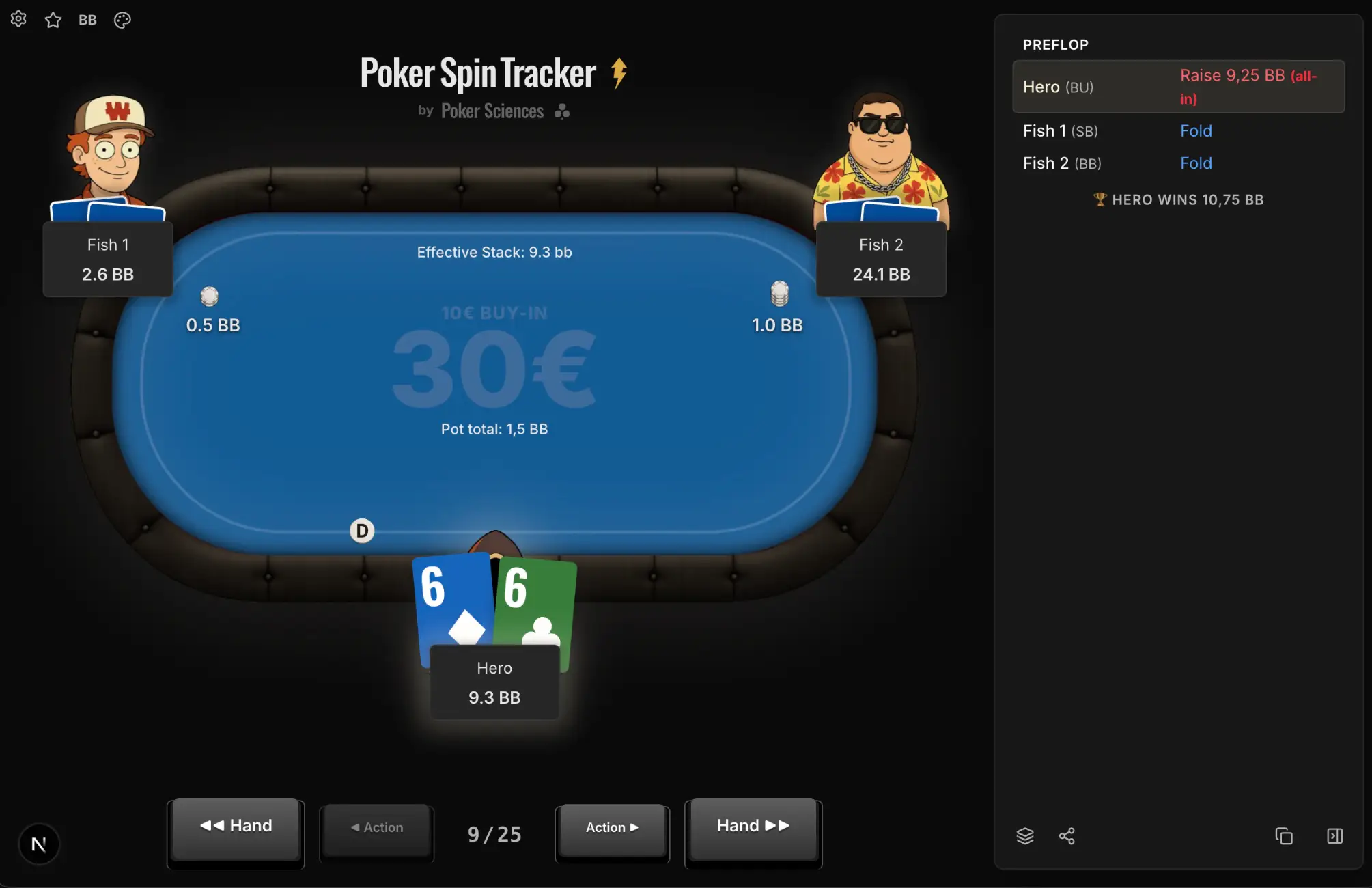
Reviewing your hands isn't mandatory. Everyone does it when they want, how they want, or not at all. This chapter forces nothing on you: it simply describes the three moments when reviewing your hands can make sense.
The underlying idea is simple. At the table, you decide in 2 to 3 seconds with partial information. Away from the table, with hindsight, your charts open, and the tracker's tools at hand, you see what was invisible in the heat of the moment.
You still need to know what to look for: opening your history to scroll through 50 hands as a spectator changes nothing about how you play the next day.
1. The three moments of work
You can work on your hands at three distinct moments, which call for neither the same tools nor the same mindset.
| Moment | How to handle it |
|---|---|
| Warm up | Ideally on the Trainer (active practice on your charts). Without the Trainer, quickly review a few recent Spins to get back into it. |
| Post session | While it's still fresh, review the uncomfortable spots you have in mind. |
| Cold review | Bigger sample, deeper analysis, no emotional bias. The spots you want to work on calmly. |
In other words, reviewing your hands is mostly useful for post session and for cold review. The warm up is more of a Trainer job: actively drilling your charts before firing up your tables is more effective than passively re-reading your hands.
The Quick Filters, which we'll cover later in the module, let you save your favorite filter combinations for these three moments and come back to them in one click, without reconfiguring everything each time.
2. A simple piece of advice: one spot at a time
When you start reviewing your hands, the temptation is usually to look at everything: you open the history, scroll through 50 hands in spectator mode, tick a mental box, and go back to playing. In practice, very little actually sticks.
What works better for most players is to take one precise spot and work it thoroughly across all your filtered hands, with your reference chart open and a postflop tool if the spot calls for it. You're no longer looking at an isolated case; you're seeing your pattern in that situation.
A spot is defined by a simple combination: your position, possibly your stack, and the action (preflop or postflop) that precedes your decision. A few examples:
- BB vs SB open 2 bb at 12 bb
- M3 BTN open-raise at 20 bb+
- SB vs BB 3bet shove at 15 bb
- BTN vs BB SRP, turn 2-barrel after a flop c-bet call
- BB vs BTN SRP, defending against a reg's flop c-bet
No need to be that precise about the stack every time: a wide bracket (12 bb+ for example) often does the job.
What matters is grouping hands that really play the same way. Ideally you go even further and separate vs reg and vs fish spots: the ranges aren't the same, and neither are the adjustments.
If you are unsure which spot to pick, here are a few useful pointers, in order of priority:
- The spots flagged by the preflop mistake detector: you already know you deviate on them (we'll come back to this detector in a later chapter)
- The recurring spots in your format (c-bet, 2-barrel, defense vs c-bet, delayed c-bet, etc.): fixing a single one of these spots pays off across hundreds of hands
- The spots where you hesitate at the moment of decision: a zone of discomfort is often a zone of progress
The tools we'll see later in the module (advanced filters, preflop mistake detector) are designed precisely to isolate this kind of spot.
Watch out for the trap of the one-off big pot. A hand lost in a huge pot leaves an emotional mark, but if that spot doesn't come up often, its impact on your average EV is negligible next to a spot that plays out dozens of times per session. Frequency matters more than pot size.
3. The 4-step method
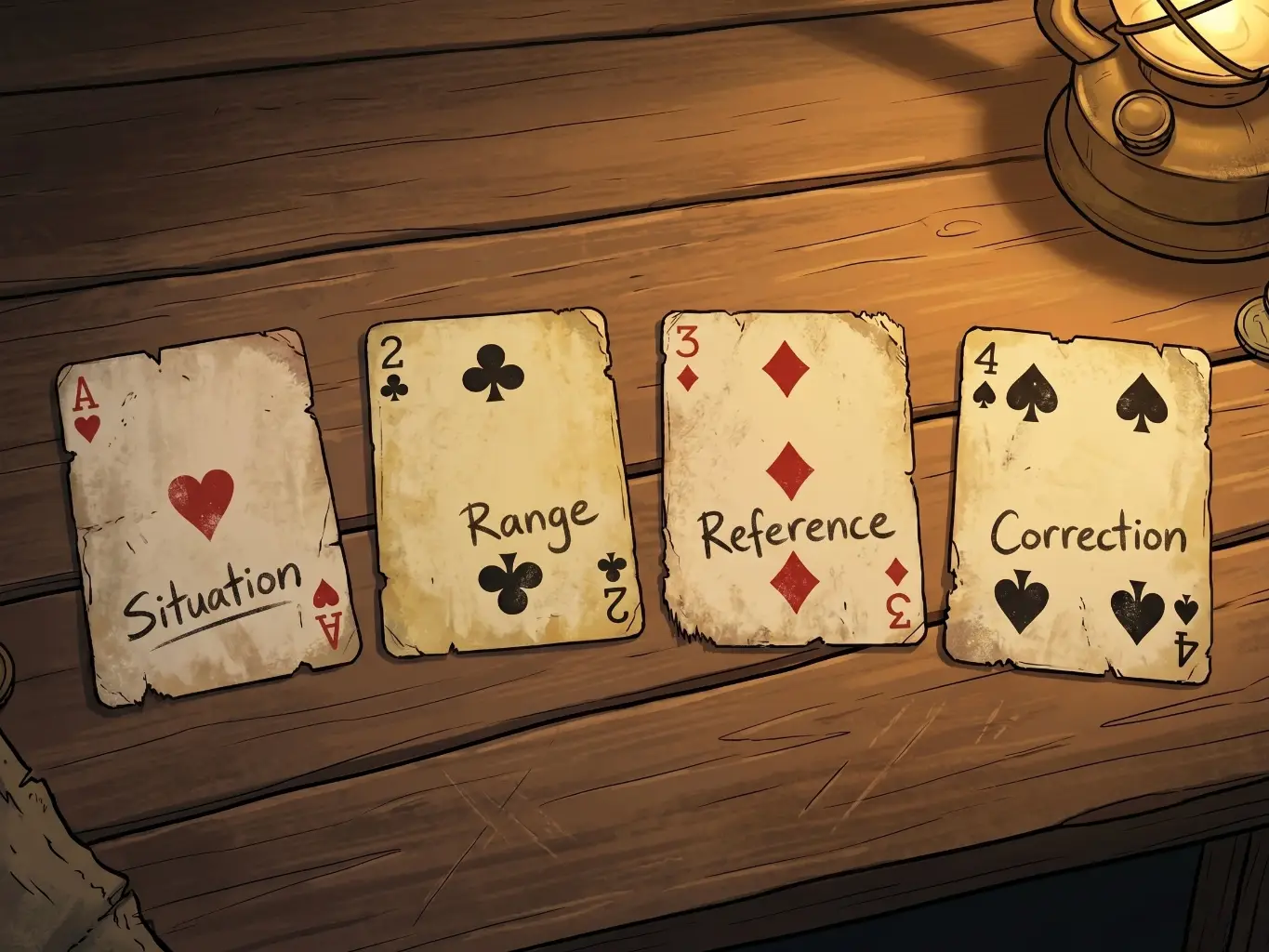
Once your sample is filtered down to a spot, here is a simple way to approach each hand, in 4 steps:
1. Set the scene without looking at your cards.
Rebuild the exact context of the decision: your position, the effective stack, how the preflop action unfolded, and what you know about your opponents if you have a read on them.
2. Play the range, not the hand.
When you think about a spot, you should always reason about your whole range in that situation, never about the single hand you have in mind. Otherwise you patch together case-by-case decisions, with no overall consistency.
- Against a reg : thinking about your entire range is the only way to balance your strategy: without it, your lines become readable, and therefore exploitable. More broadly, it's also the right way to structure your poker thinking: reasoning that holds up across the whole range, not a patchwork of isolated decisions.
- Against a fish : balance barely matters, but reasoning in ranges forces you to go through every possible hand in the spot in one pass. You work the situation from A to Z rather than combo by combo. For example: "I bet big for value with the top of my range, I bet small with the middle of my range to protect without overexposing myself, and I check the bottom of my range".
Once the blocks are laid out (what you value, what you bluff, what you check), it usually gets easier to place your hand in the right category.
And even if your conclusion turns out to be wrong, simply questioning yourself actively about the situation is already a huge driver of progress: little by little you build your reading framework, you strengthen your reasoning, and it's that regular work that ends up paying off at the tables.
3. Compare against a reference.
If you're comfortable with the dedicated tools, you can go further, and even replace step 2 directly with this comparison. Compare your reasoning (or analyze what theory says in that spot): either pure GTO theory, or theory against the ranges built from your opponents' data (nodelocking).
The Leak Finder module will come back to these approaches in detail; we won't unpack them here.
4. Phrase the fix as one actionable sentence.
An actionable fix is a sentence you can apply from your very next session. Not:
I need to play BB vs SB better
Too vague. But:
BB vs SB at 12 bb facing a 2 bb open, I 3bet shove most of the top of my range
Precise, immediately applicable.
If you can't phrase your fix in one clear sentence, it means you haven't understood your mistake yet. Go back to step 3.
4. Key takeaways
Reviewing your hands isn't an obligation, but when you do it, a bit of structure changes everything.
• One spot at a time, worked through thoroughly across all your filtered hands.
• Priority on frequency, not pot size. Ideally, separate vs reg and vs fish.
• Think range, not hand: strategic balance vs reg, full coverage of the spot vs fish.
• A 4-step method for each hand: set the scene, play the range, compare against a reference, phrase the fix.