Building your improvement routine
Find the balance you enjoy between playing and studying, and keep it up over time.

Gandalf
Co-founder of Poker Sciences

There is no one right routine for improving at poker. There is only the one you manage to keep up over time, the one that brings you back to the tables or to your study without it feeling like a chore.
Everyone builds it their own way, depending on what they enjoy and on the period they are in. The only criterion that really counts is the enjoyment you get out of it: without it, no routine survives long enough to have any effect.
That is also what Poker Sciences tries to make easier: giving you the right tools to find your balance between playing and studying, and the motivation to keep it going over time. The leaderboards, the flames, the Trainer and the illustrated guides all exist for that!
1. The two modes of poker
Playing poker ultimately comes down to two cognitive modes.
| Mode | What it covers |
|---|---|
| Play | The essential one: it's what brings in the money. And along the way, it's also the raw material for everything else: without volume, no hands to analyze, no feel at the tables, no exploit to build, no improvement. |
| Study | Understanding. That covers reviewing your own hands just as much as working on charts, concepts or postflop situations. Either way, you go back over the game cold to master it better in the next session. |
Every player enjoys each of these two modes more or less. It can also shift from one period to the next, and that's no problem. The balance between the two shapes your current profile.
| Profile | Play | Study |
|---|---|---|
| Grinder | 80% | 20% |
| Balanced | 60% | 40% |
| Scholar | 40% | 60% |
To give you a personal example: I have always leaned toward study rather than grind.
The pace of sessions can end up wearing me down, but taking a spot apart or having a concept finally click can keep me hooked for hours. That's my engine, and that suits me just fine.
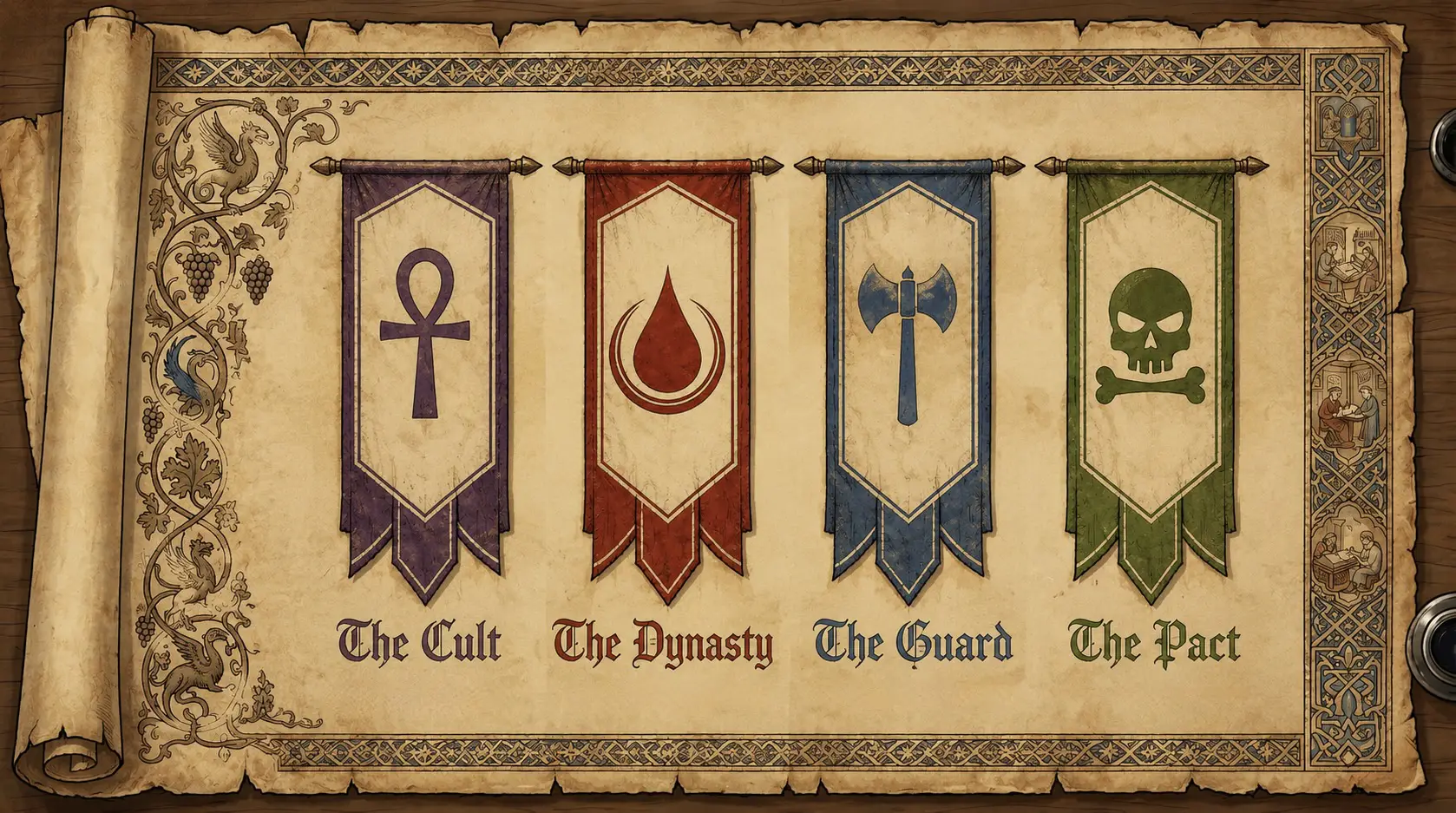
There are 4 great Factions, created by the Kingdoms to train the best poker players in the Known World: the Dynasty, the Guard in the Northern Kingdoms, the Pact and the Cult.
But we'll have time to come back to that.
2. Enjoyment first
Poker is played over years, and no routine holds up if you are only enduring it. The only criterion that survives over time is the enjoyment you get from it.
You can enjoy understanding, you can enjoy playing, you can enjoy doing both. What matters is to own what you love: forcing yourself down a path that isn't yours leads to demotivation, and poker stops fast once motivation is gone.
In the long run, the player who enjoys the game almost always beats the one who forces themselves. Not only because they play better in the moment, but because they're still around in two years, when the other has already quit.
The choice of study tools also weighs heavily on that motivation. That is one of the reasons Poker Sciences tries to gamify learning as much as possible (Trainer, flames, leaderboards, illustrated guides): the more enjoyable the work is made, the more you come back to it.
It can never be said often enough: be careful to tell the enjoyment of the game apart from addiction. It goes without saying, but the moment poker puts you at risk (financially, socially, or in terms of your mental or physical health), it's no longer enjoyment: it's a dependency, and it has to be dealt with.