The 4 profit modes
Profit, Effective EV Profit, EV Profit and EV Multi Profit: four perspectives on your earnings.

Gandalf
Co-founder of Poker Sciences

As explained in the previous chapter, the Profit KPI is clickable. Clicking it switches between four modes: Profit, Effective EV Profit, EV Profit, and EV Multi Profit.




In this chapter, we'll simply walk through what each mode measures. Deeper analyses (gaps between modes, projections, spotting lucky or unlucky runs, effective rake in detail) will come in dedicated chapters, notably the one on the Bankroll curve.
1. Profit: the real result (blue curve)

As we saw in the previous chapter, the blue curve shows your real earnings in euros, rakeback included. It's exactly the money that came into or went out of your bankroll on your room over the filtered period.
It's the simplest curve to read, and it's also the most misleading on a small sample. A weak player can be well in profit thanks to a lucky x25. A good player can be in the red for thousands of Spins despite having played well.
The blue curve doesn't separate performance from luck.
That's why the pink curve is just as fundamental.
2. Effective EV Profit: expected performance (pink curve)
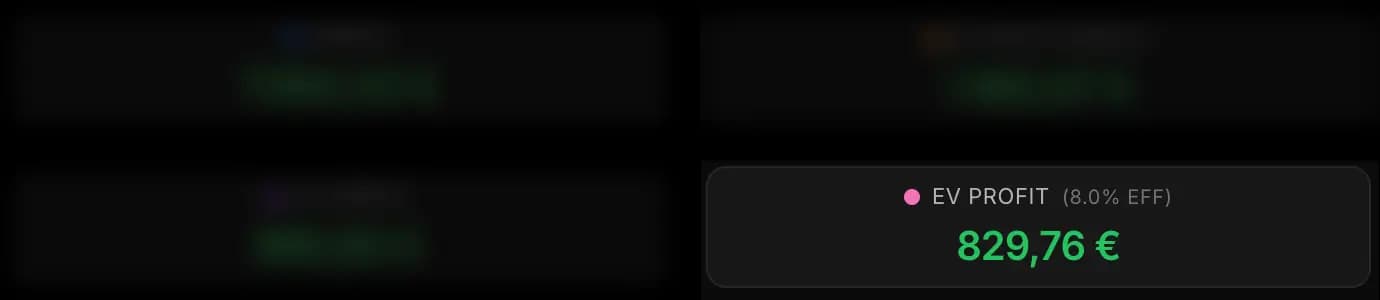
The pink curve is the most realistic curve we've managed to build to date, and as far as we know no other tracker offers it today.
It shows what you should have won given your skill level (CEV) and the multipliers you were statistically expected to hit over your played volume.
To understand why it matters, you have to go through the concept of effective rake.
Effective rake
Let's take a room at random: Unibet. The x2500 drops there on average once every 100,000 Spins. The presence of these big multipliers may seem trivial, but it's actually far from it. It has a real negative impact on your long-term earnings.
Indeed, for the x2500 on Unibet for example, even playing 100,000 Spins, you only have a 63% chance of having hit it at least once, and therefore a 37% chance of never having had it.
On a smaller volume, you'll almost never hit it.
The effective rake is your rake recalculated with the multipliers you were statistically expected to hit over your played volume, and not over an infinite volume. The lower your volume, the higher your effective rake.

The pink Effective EV Profit curve takes this aspect into account (on top of your skill level, i.e. your CEV) to give you an accurate and clear estimate of what "you should have won" over your played volume.
3. The other two modes: EV Profit and EV Multi Profit
The two remaining modes have their uses, but they're more technical and reading them day-to-day can blur your understanding. We'll introduce them here in a few words, and come back to them in detail in the chapter on the bankroll curve.

EV Profit (purple curve): your theoretical long-term profit based on your CEV and the average multiplier distribution of your room. It completely ignores the multis you did or didn't hit, and projects what you'd win over an infinite volume.
EV Profit therefore differs from Effective EV Profit in that it doesn't take into account the fact that the rarity of big multipliers (x2500, etc.) affects your earnings.
A concrete example
Take a player on Unibet €5 Flash: 10,000 Spins, 14 CEV, 50% rakeback. Here's what the two curves show:
| Curve | What it says | Amount |
|---|---|---|
| Purple (EV Profit) | What I would win on average in the very long run | €1,467 |
| Pink (Effective EV Profit) | What I should win with the multis I was realistically likely to hit | €1,029 |
The €438 gap is the EV "invested" in the big multis he hasn't hit yet. The purple curve makes him believe he's running at €1,467. The pink curve tells him the truth about his sample: €1,029. The rest may come later, once he's played enough to hit his expected x100 and x2500, which will take time.
The pink curve converges toward the purple one
The more your volume grows, the closer the probability of having hit each multiplier gets to the long-term reality. So the pink curve gradually catches up with the purple one: at 100,000 Spins the two values are practically on top of each other, at 10,000 the gap can still be significant.
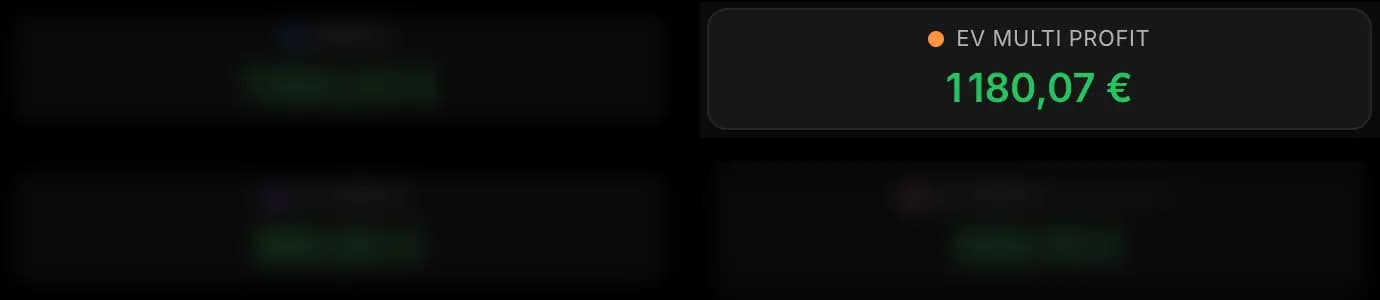
EV Multi Profit (orange curve): your theoretical profit based only on the multipliers you actually got, neutralizing all-in variance. It answers the question:
If I had won every Spin I was supposed to win, how much would I have made with the multis I actually hit?
Concrete example
Imagine you get lucky and hit an x1000, but you lose the Spin even though you were the favorite to win it. The orange curve is going to shoot up, because "you should have won all that money". But this curve doesn't account for the fact that you were lucky to get that x1000 in the first place. The purple and pink curves do account for it, and would barely have moved in the same situation.
By default, we recommend watching the blue curve and the pink curve only.
The two other curves (purple and orange) we've just covered remain useful, but only for certain specific analyses.
These two curves are covered in depth in the chapter The Bankroll curve, where we'll see how to read the gaps between the four curves, enable projections, and spot good or bad runs.
Key takeaways
The Profit KPI has 4 modes: 4 ways to read the same earnings.
The blue curve tells you what actually happened, the pink curve what should have happened given your volume. Together, they're enough to understand whether a good or bad run comes down to your play or to variance.
| Curve | What it shows | When to use it |
|---|---|---|
| Profit | Your real earnings in euros | Day-to-day, for the concrete result |
| Effective EV Profit | What you should have won on your sample | Day-to-day, to measure your expected performance |
| EV Profit | Pure long-term EV-earnings, based on the room | Projections at infinite volume. Useful for studying your room's profitability (see Bankroll chapter) |
| EV Multi Profit | EV-earnings with the multis you actually got | One-off analyses (see Bankroll chapter) |