The 4 Dashboard KPIs
Tournaments, CEV, Rakeback, Profit: understanding the difference between result and performance.

Gandalf
Co-founder of Poker Sciences
Welcome to module 2! Module 1 was fairly basic all things considered, but things are about to get more technical from here on. So let's get to it.

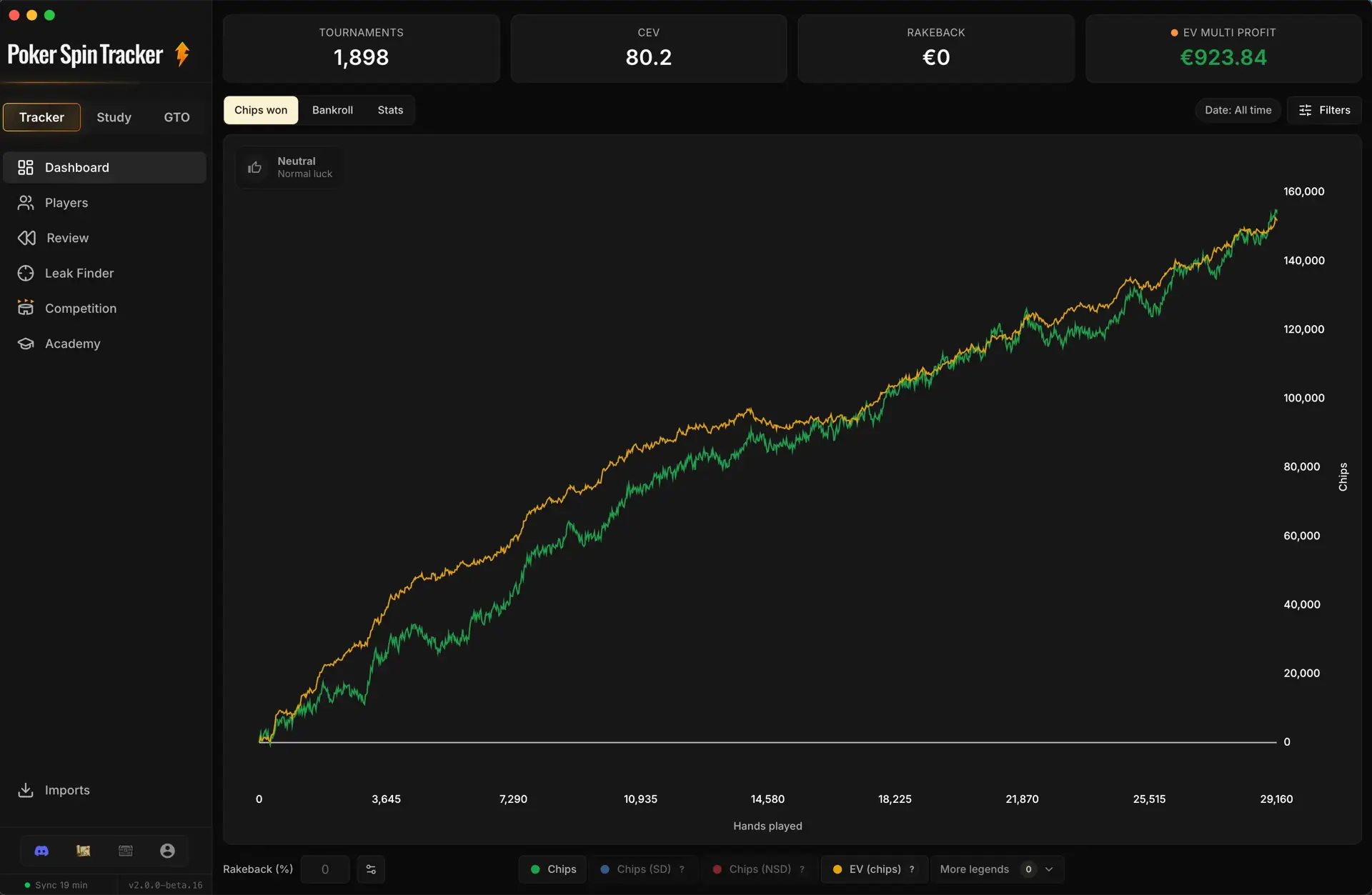
The Dashboard is the first thing you see when you open the tracker. At the top of the page, four cards sum up the essentials: the KPIs (Key Performance Indicators). This chapter explains what each one measures, and why one of them matters more than the others.
1. Tournaments: the foundation of everything

The first KPI we're going to talk about is the Tournaments KPI, which simply shows the number of Spins played over the selected period. It's a simple but fundamental piece of data.
In Spin, volume is king. The more you play, the more reliable your data becomes, the more your analysis makes sense, and if you're a winning player, the more money you make. Conversely, with too few tournaments, all the other data in the tracker is statistical noise that's hard to interpret. It's the first pillar of the Spin player, as you now know.
So how many Spins does it take before the tracker really starts to show anything interesting?
100 Spins is far too few to draw any conclusion at all.
1,000 starts to give you a trend.
2,500/5,000+, and your data becomes usable.
This doesn't happen in a day of course, it takes time, so import regularly to build a solid sample.
This KPI is clickable: one click toggles the display between the number of Spins and the number of hands played over the period.
2. CEV: the quality of your play
CEV (Chip Expected Value) is the average number of chips you win per game. It's the most important KPI in the tracker, because it measures your performance, not your result.

What I mean by that is that with your CEV, you can work out whether you're a winning or losing player, and you can assess your level of play compared with the other players at your stake.
The CEV KPI is clickable too: switch between CEV (per game, the default display) and CEV per hand ("CEV / hand").
We won't go into the details of CEV here: we devote an entire chapter of our free course to it. If the concept is new to you, start there before going any further.
You're probably wondering: what counts as a good CEV?
If your CEV is above 0, it means you play better than your opponents on average (you win more chips than you lose), which is already good. But to make money in the long run, you need to do a lot better than that.
Ideally, find out by talking with players from your room. Otherwise, keep reading: there are tools that will help you find the minimum CEV needed to be a winner.
There is no universal rule of thumb for what a good CEV is. Reference CEVs are specific to a room and a format: the starting stack and the blind level duration change everything. No value or progression by stake works perfectly from one context to the next.
The only constant: the further you move up in stakes, the more regs you run into at your tables (that's the second pillar of the Spin player: the fish/reg ratio), and the more your CEV mechanically drops.
So to sum up, CEV is the KPI to watch first. If your CEV is good, you're playing well, even if your profit is temporarily negative.
3. Rakeback

The third KPI shows the rakeback. In concrete terms, every time you fire up a Spin, the room takes a commission (the rake). The rakeback is the share of that commission the room pays back to you, as cashback, bonuses or tickets.
The higher the stakes you play, the bigger a part rakeback plays in your profitability. At high stakes, a substantial share of regular players' earnings comes from rakeback.
In general, rakeback ranges from 0% to 5/6% of the buy-in on the best .com deals. In other words, every time you fire up a €10 Spin, depending on your rakeback offer, you could get between 0 and 60 cents straight back as cashback. Note that rakeback mainly concerns players at €5 and above.
The amount of your rakeback, which therefore varies with your room's offer (which generally depends on your playing volume), is set up directly in Poker Spin Tracker. We'll see how to configure it in an upcoming chapter.
Good news: if you play on several rooms, Poker Spin Tracker lets you set a different rakeback for each one. The tracker automatically applies the right rate depending on the room where each tournament was played. We'll come back to this later.

4. Profit: the final result

The fourth KPI shows your profit in euros, rakeback included. It's the number everyone cares about, but it's also the most misleading one on a small sample.
Profit is heavily affected by two sources of variance in particular:
- Luck in all-ins: the cards that come on the board
- Luck with multipliers: the jackpots you hit
So a good player can lose money over 500 Spins simply because they didn't hit the right multipliers. The reverse is just as true: an average player can end up well ahead thanks to one x25 they were lucky enough to get. That's why profit alone is not a good indicator of your level of play.
This KPI is clickable: clicking it switches between four different profit modes (Profit, Effective EV Profit, EV Profit, EV Multi Profit). Each mode neutralizes part of the variance. That's the subject of the next chapter.
Key takeaways
You now know the four KPIs that sum up your activity on the Dashboard. The essential distinction: CEV measures how you played (performance), Profit measures how much you won (result). On a small sample, the two can tell very different stories.
• Tournaments = the volume of Spins played. Without enough volume, all the data is noise
• CEV = your performance in chips, independent of luck. It's the most important KPI
• Rakeback = the cashback paid back by the room. Part of your real earnings
• Profit = the final result in euros, rakeback included. Affected by variance