
CEV: traps to avoid
The 4 most common interpretation mistakes around CEV, worth knowing before you draw any conclusion at all.

Gandalf
Co-founder of Poker Sciences

Since the beginning of this module, we've been repeating the same thing: CEV is the Spin player's ultimate judge.
It's the only metric among the 4 main KPIs that truly measures your skill level, independently of everything else. But CEV is not a magic number. Misread, it can lead you to false conclusions about your level, your progress or your opponents.
This chapter gathers the 4 traps that come up most often around CEV. Knowing them protects you against most of the interpretation mistakes we come across, from beginners and experienced players alike.

1. Comparing CEV across different rooms or formats
First reflex to avoid: directly comparing your CEV on one room with a friend's on another, or your standard Spin CEV with your "Ultra" / "Flash" Spin CEV. Reference CEVs are specific to a room and to a format.
The reason is simple: CEV essentially depends on two structural parameters:
- the starting stack (number of initial blinds)
- the blind level duration (how fast the structure speeds up)
The deeper the starting stack and the longer the levels, the more hands you have to play, so the more opportunities you get to put your edge to work.
It's harder to have a +10 CEV on a Turbo format than on a slower standard format.
Same logic on the time axis: comparing your current CEV with a room's CEV from several years ago makes no more sense. Rooms regularly change the structure of their Spins (starting stack, level duration). A reference CEV that was circulating on a forum 3 or 4 years ago may simply no longer match the format you're playing today, even if the room name and the buy-in are identical.
Only compare your CEV with that of players on the same room, the same format and in the same era as you. As soon as one structural parameter changes, the raw comparison loses its value.
2. CEV doesn't tend toward infinity
Many players picture CEV as a straight line: the better I get, the higher my CEV goes, and there's no limit. Intuitively, that's appealing. In practice, it's wrong.
CEV actually tends toward a finite limit, equal to the sum of your opponents' mistakes minus the sum of your own mistakes. Both quantities are finite.
Good news: your own mistakes can quickly approach 0 with a solid preflop and good postflop mastery. Once past that milestone, the only real ceiling on your CEV is the sum of the mistakes your opponents are willing to make.
If one day everyone at your table played perfectly, your CEV would be close to 0, no matter what strategy you put in place.
Why your CEV approaches a ceiling
Your skill grows linearly, but your CEV follows a logarithmic curve: the first gains are huge, then the ceiling closes in.
Direct consequence: the sum of your opponents' mistakes depends on the average composition of your tables. The more fish at your tables, the more mistakes pile up and the higher your ceiling. Conversely, the more regs, the rarer the mistakes and the lower the ceiling gets.
So the same player will see their CEV drop when moving up in stakes, not because they're playing worse, but because the ceiling has dropped as fish have become scarcer.
And bingo: we land right back on the 2nd pillar of the Spin player, table quality. It's this pillar that pushes you to:
- choose your time slots to play when the most fish are online (evenings, weekends, etc.),
- choose your room and your buy-in based on the fish/reg ratio of the pool,
- only move up in stakes if the higher buy-in (and therefore the higher earnings in euros) makes up for the mechanical CEV drop tied to the scarcity of opponents' mistakes.
So don't panic if your CEV drops after moving up in stakes. It's a sign that your opponents are making fewer mistakes, not necessarily that you're playing worse. What matters is that your earnings in euros keep going up.
3. Beware of the CEV numbers seen on Discord
Third trap: comparing yourself to CEV numbers seen on Discord servers. You've probably already come across a screenshot along the lines of "I ran X CEV over 15,000 Spins at stake Y". These numbers are sometimes dizzying, and they can easily make you doubt your own level.
It's also often a very effective marketing move: an impressive CEV serves as a hook for a video, a thread, a training program or a coaching offer.
The problem is that these runs are almost never representative. This is called survivorship bias: out of 100 players of a given level who play 15,000 Spins, there will always be 10 posting a CEV well above average, purely down to luck. Those are the runs that end up on Discord, and those same runs are the ones used to promote training programs or coaching. The other 90, who played just as well but ran worse, are never heard from. Only the top statistical CEVs stand out, and that's what you see scrolling by everywhere.
Survivorship bias
The silent majority of "average" players (center) makes no noise. Only extremely high CEVs stand out and feed YouTube, forums, or social media.
And even on a large sample size (15k, 20k, 30k Spins), variance on CEV remains far from negligible. We'll see in the Understanding variance module why the confidence interval stays wide even on what look like large samples.
Don't be too hard on yourself or on your CEV. It's easy to lose touch with reality trying to reproduce the runs of the lucky top 10% you see going by here and there on the internet.
Your real benchmark is yourself and all the work you put into your progress and into the analysis of your game, not an isolated screenshot.

One last word on the mental side. Constantly comparing yourself to CEVs displayed on the internet is toxic: you never feel good enough, and you can spend all your time looking for excuses for a level you believe is within reach when it isn't, at least not in your pool, in your era, on your sample. It's a highway to frustration.
Careful with the opposite extreme. If you're a beginner or intermediate, your CEV still has plenty of room to grow and there's still a lot to learn: don't use this trap as an excuse to stop making progress.
But once your CEV is decent for your pool, remember that its growth is capped (see trap 2). In Spin, your results rest on three pillars: your skill, your volume and your fish/reg ratio. Keep pushing each of those pillars forward. And don't forget that the enjoyment of playing is fully part of that progress!
4. A low CEV at a given position is not a problem at all
This last trap is the most complex of the chapter. It introduces the notion of structural CEV, which will come back later in the modules dedicated to the Leak Finder and to the Global EV and Overview tabs. Take your time on this passage: once digested, it completely changes the way you read a CEV by position.
Final trap: worrying when you see your CEV by position close to 0 or negative at certain positions. The most classic case is the BB in 3-max.
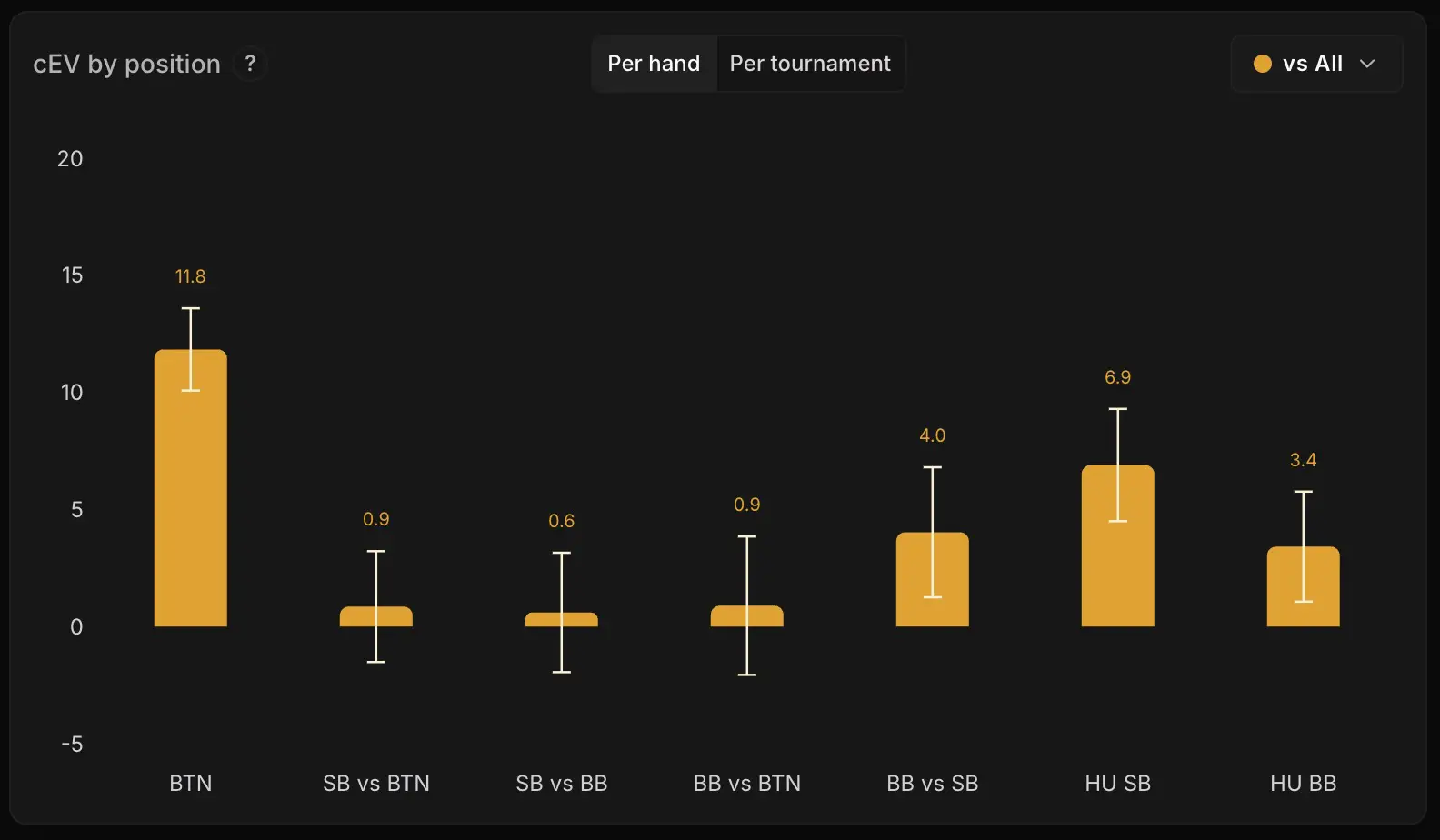
In 3-max, the BB pays 1 blind every hand without having asked for anything. It's defending, with a big positional disadvantage, against opponents who chose to attack it. It's normal to have a negative CEV at that position. Against a reg at the BTN, you'd be running more like -15 to -20 CEV in BB, and that's entirely expected.
To really get it, picture 3 players of the same level (3 identical fish, or 3 identical regs) playing against each other. Their CEVs by position won't be 0 across the board. They'll split structurally: positive at the BTN, negative at SB and at BB, with a sum that falls back to 0 across all three positions.
It's the positional advantage and the effect of the blinds that create this asymmetry, regardless of the players' level.
This is what we call the structural CEV of a position: the CEV that position should give you in your pool, even before talking about your skills or the exploits you can pull off. Each position has its own structural CEV, and the BB in 3-max structurally has a negative CEV.

So what really matters is not the absolute value of your CEV at a position, but the gap to that structural CEV. Example: if the structural CEV of the BB in your pool is -20 and you're running at -10 in BB, you're doing +10 better than the reference.
Conversely, if the structural CEV of the BTN is +10 and you're running at +14 at the BTN, you're only doing +4 better. In other words, a -10 in BB can be a better performance than a +14 at the BTN, even though the first number looks scary and the second one reassuring.
Even more interesting, there's a paradox worth knowing: defending situations (BB facing an open, BB facing a limp) are often the ones where you make the most EV against fish. Fish play too wide, too loose, too passively, and it's in BB that you cash in on it the most.
In short, even with a small CEV in BB, this position can remain one of your most profitable ones as soon as your tables are full of fish.
So never judge a position in isolation based on CEV alone. A BB at 0 isn't a leak, it's often the expected theoretical behavior. We'll come back to the detailed reading of CEV by position, and to the gap to the structural CEV, in the Your opponents under the microscope and Finding (and fixing) your leaks modules.
Key takeaways
CEV remains the Spin player's ultimate judge. But to draw the right conclusions from it, you need to read it with a few guardrails. These 4 traps are the interpretation mistakes we see most often.
• Trap 1: only compare what's comparable, same room, same format (stack, level duration), same era.
• Trap 2: CEV tends toward a finite limit (your opponents' mistakes). It mechanically drops when you move up in stakes.
• Trap 3: the outstanding CEV numbers seen on Discord can often be lucky runs from the top 10%. Don't compare yourself to them.
• Trap 4 (advanced): a low CEV at a given position (BB 3-max for example) is not a leak at all. What matters is the gap to the structural CEV of that position in your pool, not the absolute value.