Why analyze your data?
Welcome to this Poker Spin Tracker course. Let's start simple: three concrete reasons to use a tracker.

Gandalf
Co-founder of Poker Sciences

One thing is certain in Spins: every good player uses a tracker. It's something all regulars have in common, without exception.
The reason is simple: without organized data, you're playing blind. And playing blind, as you can imagine, is not optimal.
Thanks to a tracker, a serious player gets access to information that would be impossible to obtain otherwise, and that's a decisive edge.
There are 3 main reasons to use a tracker. Let's go through them, from the most intuitive to the most technical.

1. Analyze your meta
By "meta", we mean everything that isn't directly about analyzing your game (that's the next part), but everything around it.
If that sounds a bit vague, here are a few examples to make it clearer. Getting all this "meta" data is usually the very reason people download a tracker:
- How many tournaments did I play this month?
- What's my real profit?
- Which buy-in am I most profitable at?
- How much do I make per hour?
Without a tracker, these questions never get a reliable answer. With one, you get all of these metrics: profit, bankroll, profit by position, profit per hour, play time, rakeback... It's all there, session after session.
Every tracker picks which metrics it implements, and above all which ones it builds by default.
Since Poker Spin Tracker is built specifically for Spins, every metric that matters to Spin players is available right away, with no complex setup required.
When you analyze your "meta", it's important to look beyond the raw numbers. You have to separate the result (what happened) from the performance (how you played). Understanding that distinction means understanding that luck and skill aren't measured the same way.
It's one of the most important lessons a tracker teaches you.
You can lose money over a stretch while playing very well, and vice versa.
That's the harsh law of poker, but it's also why you have fish at your tables: if they lost all the time, they wouldn't be there.
But at the end of the day, the bottom-line metric we care about in Spins is €/h.
Every other piece of data serves, directly or indirectly, to optimize it.
2. Analyze your game
Knowing where you stand is good. Knowing how to improve is even better. That's the second reason to use a tracker: spotting your leaks.
A leak is a mistake you repeat over and over without necessarily noticing it. And this is where your brain plays tricks on you: it remembers the spectacular bad beats and ignores the small, unremarkable hands.
Yet it's often those hands, played hundreds of times over, that cost you the most. A small leak, repeated over 5,000 Spins, can add up to a serious amount of money.
How do you find them?
By comparing your actions to reference actions.
Of course we'll get into this in much more detail in the coming chapters, but for now just keep in mind that it can mean, for example, comparing your preflop play to charts, comparing your play vs fish to charts vs fish, analyzing your postflop actions against those of strong players, and so on.
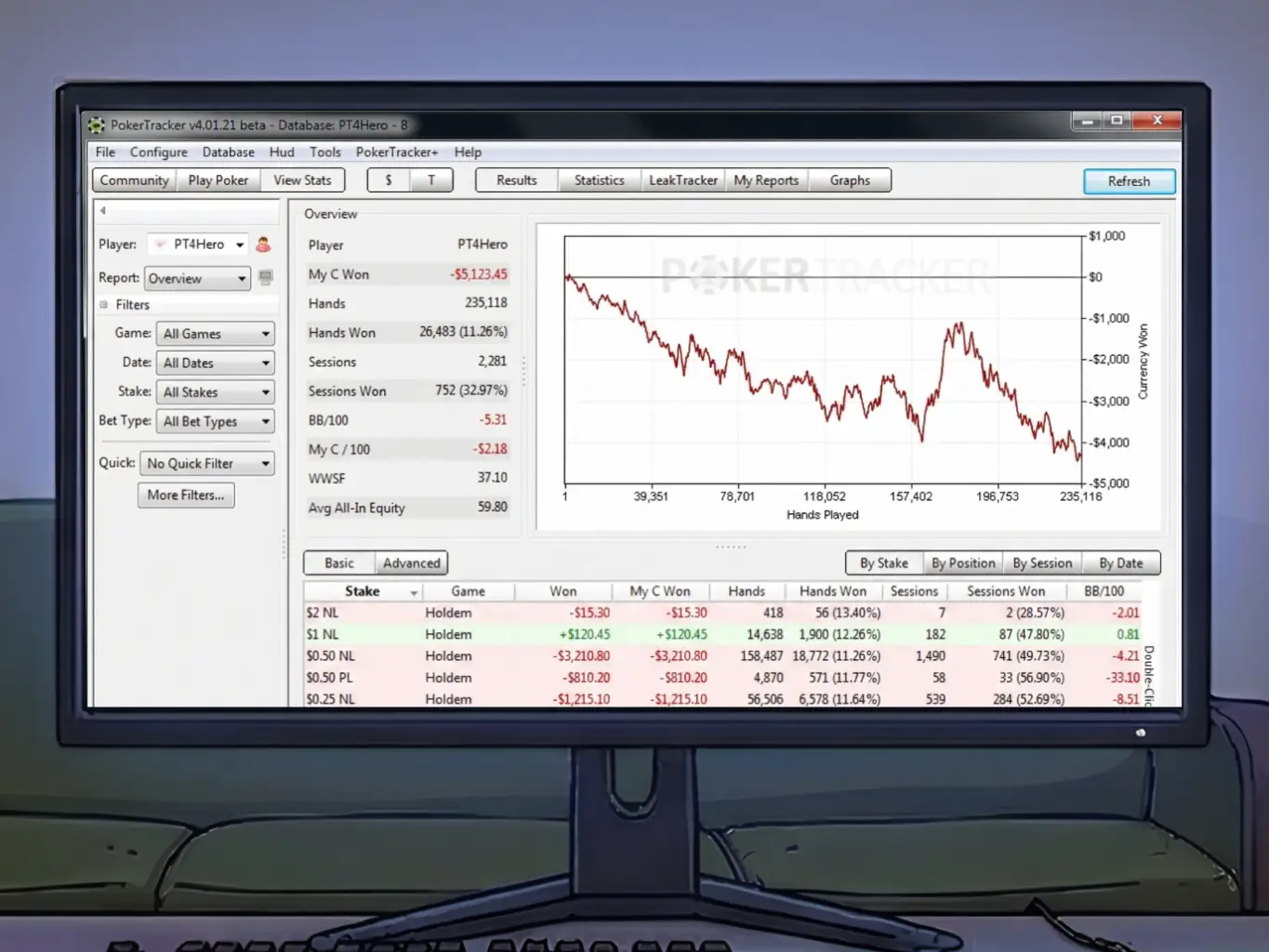
Plenty of players find this step intimidating, because mainstream trackers (PT4, Hand2Note) do very little to make it easier. They're built for MTTs and Cash Games, not for Spins.
Note 1: Bars can be wide because within the same field (for example "Analyze your meta"), some data can be very easy to find while other data can be very difficult to obtain.
Note 2: For Poker Spin Tracker and Hand2Note, you can see small bars separated from the rest under "Inaccessible". This means that with these two trackers, some data is impossible to obtain. But rest assured, for Poker Spin Tracker, for example, these are pieces of information that are of very little use in Spins (for example "% BB call vs BTN open 4x").
3. Analyze your opponents' game
Once you know your own results and your own leaks, the next question comes naturally:
How do our opponents play?
Poker Spin Tracker sorts every opponent you face into two profiles: Fish (recreational players) and Regs (regulars). And these two profiles play nothing like each other.
Against a reg, the game moves closer to solver GTO theory. You don't necessarily need a tracker to anticipate how a reg is going to play.
Against a fish, on the other hand, everything changes: the sizings are different, the frequencies unusual, the ranges heavily unbalanced, the plays atypical.
It's against fish above all that data becomes valuable.
When a fish opens 3x, what's his range? When he donk bets, what does that mean? How often does he fold to a 3-bet? The tracker aggregates thousands of hands to answer these questions.
I often hear:
My field is super aggro, how do I adapt?
To which I always want to reply:
I don't believe you, because the field isn't that aggro. Show me why you're saying that.
But analyzing your opponents doesn't stop at the diagnosis. You then have to build strategies from it, and that can get complex.
But we'll get to that later, we'll have plenty of time for it...