Optimizing your multi-tabling
Find the right number of tables to maximize your hourly earnings.

Gandalf
Co-founder of Poker Sciences

Knowing how much you make per hour depending on the number of tables you play is one of the most valuable pieces of data a Spin player can have in hand. And yet almost no tracker computes it properly.
With Poker Spin Tracker, it's the other way around: two dedicated charts answer that question directly, and reading them correctly is probably the simplest way to optimize your hourly win rate.
These two charts are not equally accurate. The first is an indicator to take with a grain of salt, the second is your real decision-making tool. This chapter explains how the tracker computes them, why they differ, and how to use them.
1. How the tracker detects your table count
Before we get to charts, one basic point: every tournament you play is tied to a number of tables played at the same time (3 tables or 6 tables, for example).
Good news: the tracker doesn't ask you for anything. It works it out from the exact time each of your hands was played.
Understanding exactly how that calculation works is optional, so if you want to know more, expand the box below. Otherwise, skip straight ahead!
2. The CEV by table count chart
First chart available: in the Stats tab of the Dashboard, you can pick "cEV by number of tables played" from the dropdown of the main chart. It shows one bar per label value (1, 2, 3, 4... tables) with the average CEV and its 90% confidence interval.
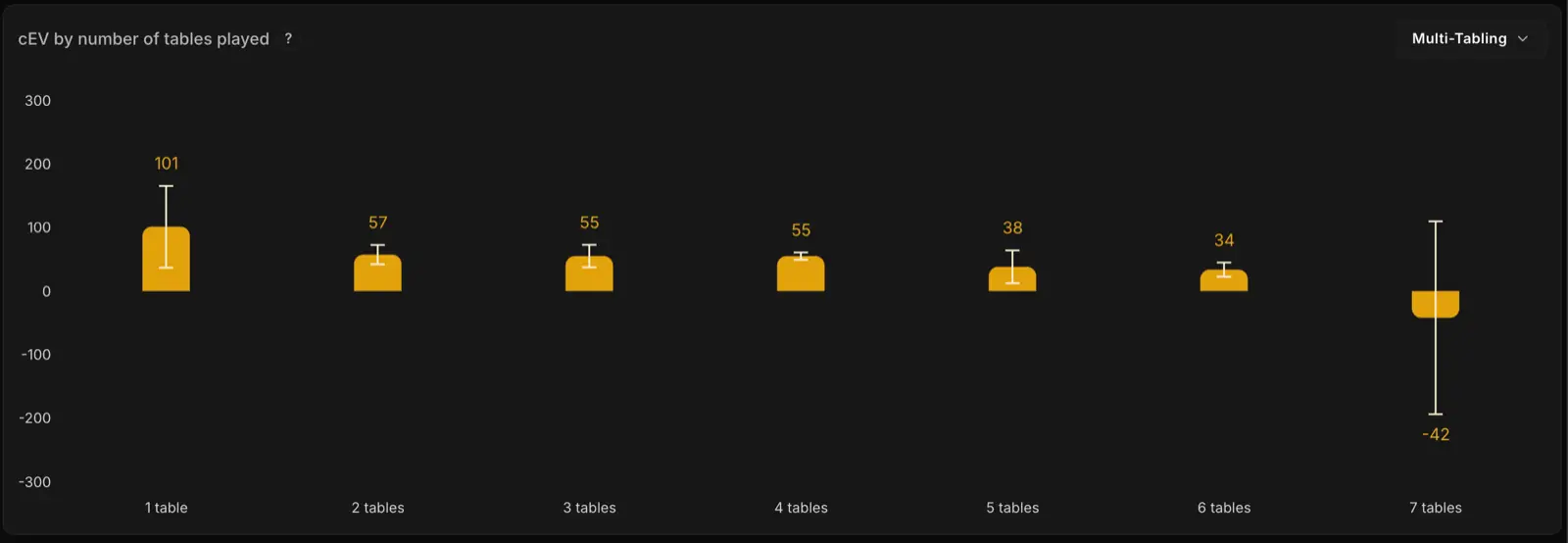
A bar shows up from the very first Spin in a bucket. But a rare value (e.g. 8 tables played a handful of times) rests on very little data: its bar is unreliable as long as the volume stays low.
How to read this chart without getting it wrong
Naturally, your CEV drops as you add tables: your attention gets split, you make worse decisions on every hand. That is expected, and it is even useful to see. But that drop is not a bad sign in itself.
The more tables you play, the more CEV you can afford to give up, because the quality you lose per hand is offset by the number of hands you play per hour.
That is why this chart, taken on its own, is almost impossible to read correctly. You have two options: either cross-reference it with an EV simulator (SwongSim and the like) to turn every CEV difference into hourly earnings, or go straight to the next chart, which tackles the real question head-on: how much am I making per hour at each table count?
It is far simpler, and that is exactly what the next section is about.
3. The €/h by table count chart
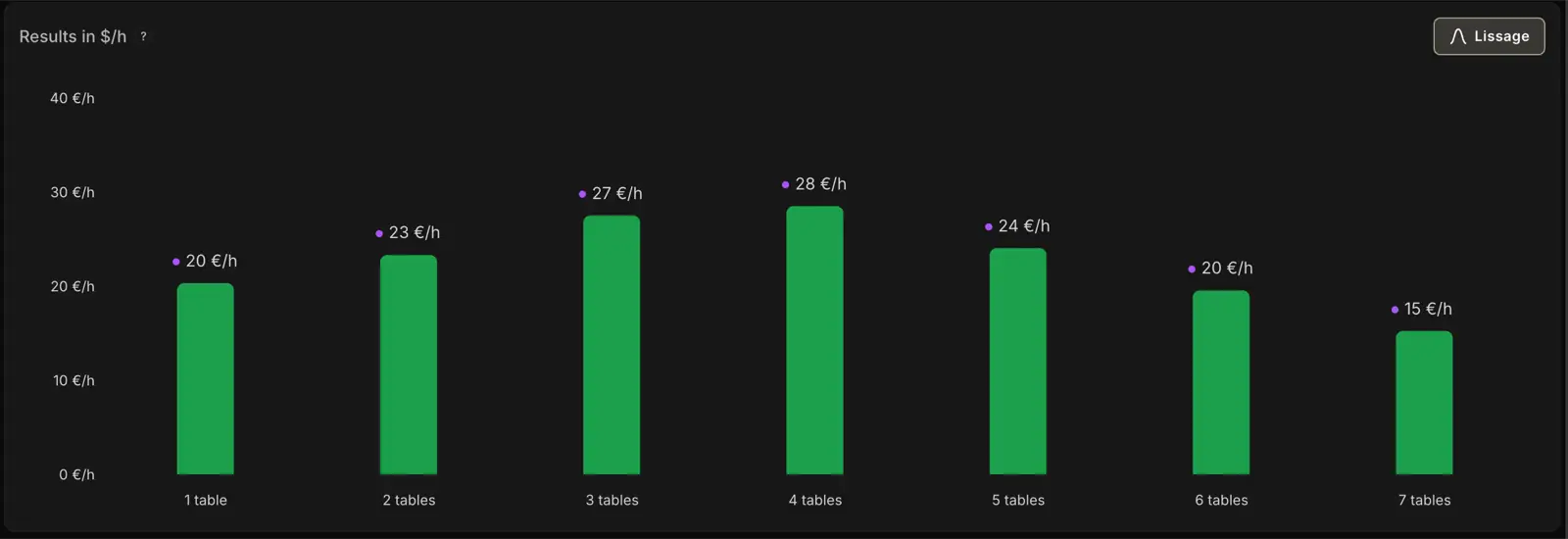
The real decision-making tool is the Results in €/h panel in the Stats tab. It shows one bar per table count, in euros earned per hour. That is the number that answers the real question.
How much am I really making depending on the number of tables I play?
The chart automatically switches to EV Profit (purple): that is the mode that strips out multiplier variance so different table counts can be compared honestly.
EV Profit is enough here, because this chart is above all about comparing setups against each other. The point is to spot the table count where your hourly earnings are highest, not to read each bar as a standalone estimate down to the cent.
The part just below is optional again. So if you want to understand how time is allocated to each bucket, go ahead; otherwise, skip to the next section!
4. The Smoothing button
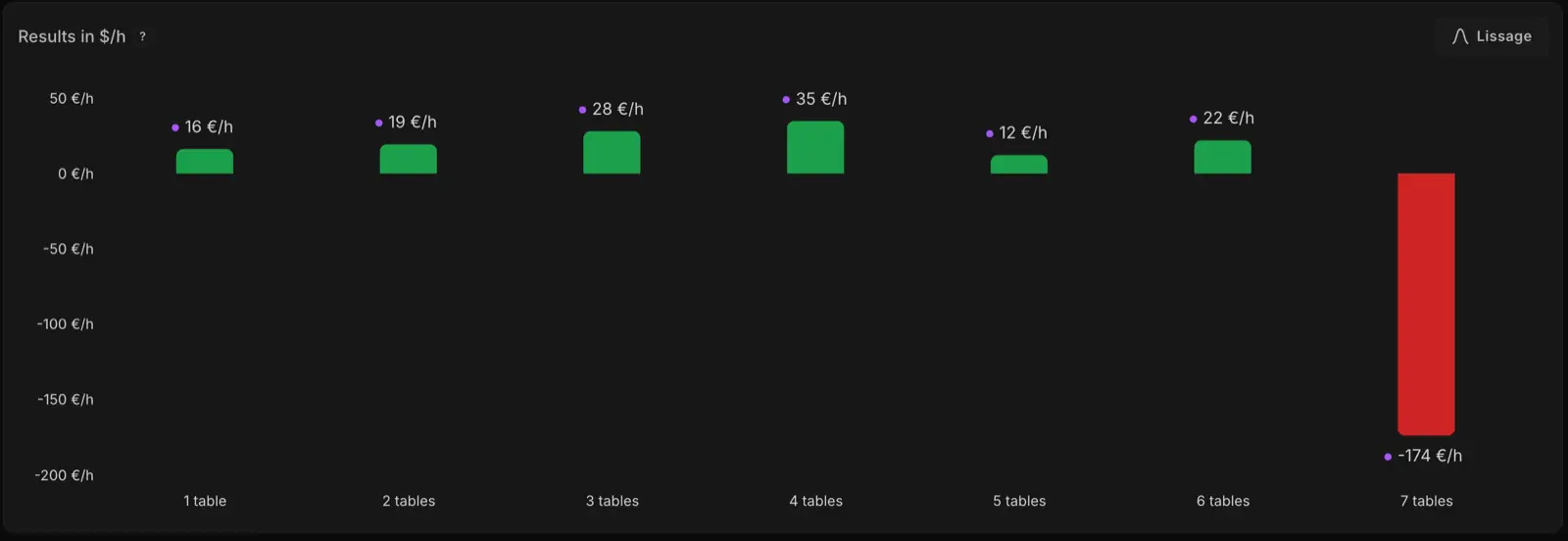
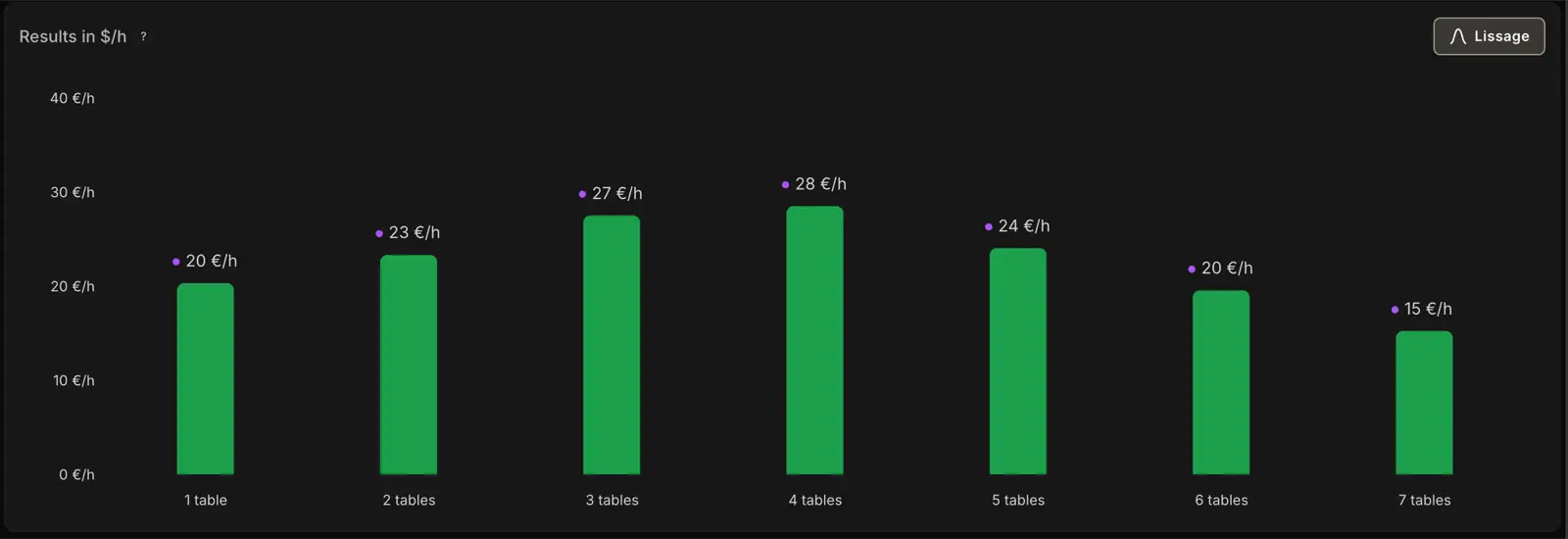
The Smoothing button, in the top right of the chart, weights each bar by its reliability (number of tournaments) and pulls it toward the overall trend. That keeps a bucket you have barely played from showing an extreme €/h that is nothing but luck, and it makes the general shape of your bell curve much easier to see.
Bars backed by plenty of data barely move, while those backed by little data are pulled toward the average of their neighbors.
5. How to find your optimal table count
If you are comfortable with how you play at your current table count, the real question becomes:
Could you make more by playing one more table?
Or the other way around, one fewer? The €/h by table count chart is built to answer that, but only if you give it the means to answer.
Experiment and build volume
The goal is to make a bell curve appear. Your €/h climb as you add tables, reach a peak, then fall back once your attention degrades too much. That peak is your optimal table count.
To find that bell curve, you have to experiment. Add a table for a few thousand Spins, then try one more, or go back down. A bar shows up from the very first Spin, but it takes far more volume to draw a real conclusion.
If you are already winning and comfortable at your current table count, you can try one more table and build volume there: it is the only way to get a reliable answer out of the chart. As long as you do not lose the thread during the session, one extra table is not going to turn you into a losing player overnight.
But watch out for the opposite excess: piling on tables is not a goal in itself. One more table also means more fatigue, more tilt and faster decisions. If you feel your game slipping, that is the signal to stop there (or even drop one), not to add another.
The right table count is not "the most windows you can open": it is the one where your €/h are highest without breaking your game.
And above all: optimizing your multi-tabling comes after mastering the game. It is not the priority when you are starting out. Begin by improving technically and putting in study time; volume and table count come later. Hunting for your optimal table count only really makes sense once the fundamentals are solid.
Watch out for variance
As long as volume is thin, the bars swing wildly. A good run of 150 Spins at 6 tables can push that bar up to 30 €/h, then a downswing over the next 150 can drag it back down to 10 €/h. Don't jump to conclusions about a bucket with little volume.
Realistically, you need something like 500 to 1,000 Spins per bucket before a reliable trend starts to show, and often a lot more for fine differences. Turn on Smoothing to cut the noise from low-volume buckets and get a better view of the overall shape of the bell curve.
Finding your optimum is not a setting you dial in once. It is a process: you experiment, you build volume, and the bell curve slowly takes shape. Once that curve is well established, its peak tells you your most profitable table count, and you can adjust your setup accordingly.
6. The gut-feeling trap
I feel like I play worse at 6 tables.
That is often true on the CEV side: your attention gets split, you miss spots. The first chart confirms it. But that is not the question.
Say that at 4 tables you run at 75 CEV and make 15 €/h. At 6 tables, your CEV falls to 60, but you play 50% more tournaments in the same hour: your €/h can climb to 18 €/h. You play worse per hand, but you make more per hour. In that case, your gut is pointing you the wrong way.
Of course the reverse happens too. At 10 tables, your CEV can crater so badly that hourly volume no longer makes up for it. Here again, only the €/h chart tells you, never your gut.
Don't run your multi-tabling on feel. A player who thinks they are "playing well" at 4 tables but only makes 12 €/h there is leaving money on the table if they could bank 18 €/h at 6.
And the other way around, a player who forces 8 tables out of pride but caps out at 14 €/h when they would do 20 at 5 tables is losing money every hour. The Results in €/h panel settles it, no debate.
Key takeaways
Multi-tabling is a trade-off between per-hand quality of play (CEV) and hourly volume. Only the second chart measures what really counts: what you make per hour.
• CEV by tables chart: indicative only. It ignores hourly volume, don't make decisions with it.
• The Results in €/h panel (by table count): the decision-making tool.
• A bar shows up from the very first Spin, but a low-volume bucket stays unreliable.
• Smoothing: turn it on to see the bell curve better when volume is limited.
• Don't run on feel. €/h settles it, not your gut.
• Multi-tabling gets optimized after you have worked on your game: it is not a race to the highest table count. Study first, then push the volume.