
Welcome to the Leak Finder
The module you've all been waiting for. On the most powerful tool in the tracker.

Gandalf
Co-founder of Poker Sciences

The Leak Finder is the most powerful tool in Poker Spin Tracker. Put simply, it has a dual purpose: finding the spots where you make mistakes in your own game, and finding those where your opponents make them so you can exploit them.
Before diving into the Leak Finder's different tabs, this chapter lays the groundwork: what a leak is, why you need a reference strategy to make it visible, and what each Leak Finder tab lets you do today.
1. What is a leak?
A leak is a suboptimal action. Concretely: at a given moment, you make a decision that isn't the one that maximizes your EV. The word means exactly what it says: something that leaks.
A suboptimal decision is a small loss on the scale of a single hand, but it becomes very costly on the scale of thousands of hands if it repeats in the same kind of spot.
The problem is that a leak doesn't show up on its own. In poker, variance crushes everything in the short term: EV gains and losses blend into good luck and bad luck.
You can make the wrong decision and win the hand.
You can make the right one and lose it.
Apart from major leaks (limping systematically on the BTN, folding all the time in the BB against a BTN open, etc.), a leak never shows up directly in your results, even over several thousand hands.
That's why the Leak Finder doesn't measure your results. It compares your game to a reference strategy.
Without a reference, there's no way to tell whether an action is optimal or not: all you're looking at is variance. With a reference and a decent amount of volume, your gaps become measurable and your leaks surface.
Over thousands of decisions, small mistakes pile up and weigh heavily on your long-term winnings.
2. The three reference strategies
A reference strategy is a known strategy that yours is compared against to measure your gaps. The Leak Finder relies on three types of reference.
None of them is perfect: they complement each other. We'll see later on which Leak Finder tab relies on which reference.
| Reference | What it is for | Its limitation |
|---|---|---|
| GTO (theoretical) | Equilibrium strategy, computed by a solver. Theoretically optimal play, whoever the opponent is. | GTO ignores your opponents' leaks. Sticking to it 100% means missing out on exploitation, which is part of what you earn in Spins. |
| Built exploit strategy | You start from GTO, then deliberately deviate to exploit the leaks of the opponents you run into at your stake. | Requires knowing your opponents' leaks and knowing how to build the deviation. It's the hardest part, but also the most profitable in the game. |
| Regs at your stake | The average strategy of the regular players at your buy-in. An empirical reference: what the players who beat the stake actually do. | It isn't necessarily optimal. Regs can share the same leaks. It's not an absolute reference. |
Concretely, GTO tells you what's correct in absolute terms. The exploit strategy tells you what's profitable against your pool. The regs strategy gives you a concrete benchmark, readable without any theoretical background.
3. Analyzing your game, analyzing your opponents' game
The Leak Finder handles both types of analysis, but they aren't at the same level of difficulty.
Analyzing your own game
This is the most accessible use. You have an external reference (GTO, regs, your own exploit reference), you look at your strategy, you read the gap.
The work takes rigor and a minimum of grounding in reading data, but the path is marked out: spot the gap, understand where it comes from, fix it.
/ Analyzing your opponents' game
This is clearly more complex. Spotting an opponent's leak isn't enough: to profit from it, you have to build a counter-strategy in your own game that directly exploits that mistake, without opening a new hole in yours along the way.
This stage mixes data reading, strategic understanding and a lot of work. It's also where the biggest room for long-term improvement lies.
In my view, this analysis is essential for players who want to understand the game in depth. It takes you through different stages of understanding and different reflections on what really matters in poker.
But don't worry: if you don't have the appetite, or not yet the level, to do that work, it's our job to hand you a first exploit-strategy reference, in the Study Pack, preflop today and postflop tomorrow.
You'll have all the time in the world (or not) to start from that reference and possibly go further, building strategies that suit your style of play better, or that are sharper against your pool.
4. The four tabs of the Leak Finder
The Leak Finder brings together four tabs.
Each one analyzes your game (and your opponents') at a specific point, with a different reference strategy, and with its own level of depth. We present them here in the order of the chapters that follow: from the most "localized" one (Preflop) to the global dashboard (Overview).

| Tab | What it does | Reference used |
|---|---|---|
| Preflop | Deep analysis. Compares your range cell by cell (13×13 grid) to our reference charts, or to your custom charts, on every situation. | Poker Sciences charts (GTO and Exploit), or your custom charts. |
| Postflop | Medium-depth analysis. Compares your postflop frequencies (c-bet, fold vs bet, etc.) to those of the regs at your stake. Gives a solid benchmark of your level, with no theoretical pretension. | Average strategy of the regs at your stake. |
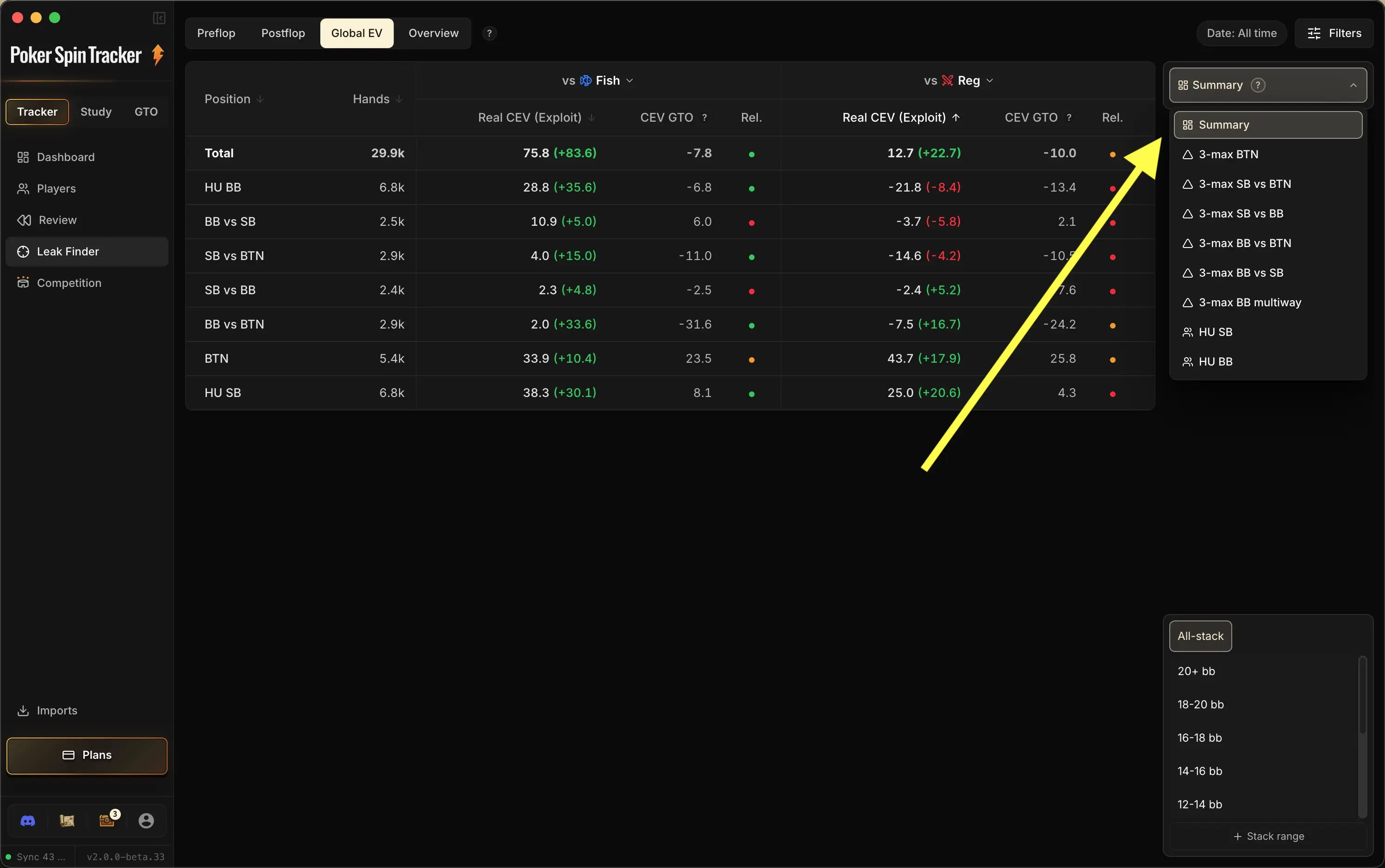
| Global EV | The most powerful tab. It measures, combo by combo, the EV in bb per hand you generate in a situation, then compares it to theory. You can also compare the EV of several actions in the same spot. | Theoretical EV coming from a solver. |
| Overview | The Leak Finder's dashboard. It brings preflop and postflop together in a single table. You'll find the general stats (VPIP, PFR, aggression...) and the precise stats of the analyzed profile: you, Fish, Regs, a custom tag or a specific player. Each cell is colored according to its gap to the reference: green when on target, red if the profile is too aggressive, blue if it's too passive. | Reference charts preflop, Regs at your stake postflop. |
Also worth noting: the Preflop, Postflop and Global EV tabs share a Summary view, the first entry in their sidebar, which condenses all their situations into a single table.
These Summary views make excellent starting points: they show you at a glance where to look first, before drilling down into the detail. We'll present them in the corresponding chapters.
5. What the Leak Finder will become
The Leak Finder as it stands only covers part of the game.
Postflop is analyzed only through the regs' average, not through a theoretical reference nor through exploit references.
The next major updates will change that. Postflop, coming to the Study Pack, will bring theoretical references to postflop. And building our own solver will make it possible to go further in building exploit strategies: it will rely directly on the opponent ranges collected by the tracker, to produce strategies genuinely adapted to your pool.
At that point, the Leak Finder will be able to analyze your game from A to Z, and even assess the relevance of your deviations: how far an exploit stays profitable, and where it starts costing you more than it brings in.
6. Key takeaways
The Leak Finder makes visible the leaks that variance hides, by comparing your game to reference strategies. It is today the most powerful analysis tool in the tracker, and it is set to become even more so with the coming updates.
• A leak is a suboptimal action. Variance hides it in your results: only a reference strategy makes it measurable.
• Three complementary references: GTO (theoretical), a built exploit strategy (your adaptation to the pool), regs at your stake (empirical).
• The Leak Finder analyzes both your game and your opponents'. The second use is more demanding: it requires building a counter-strategy.
• Four tabs, in the order of this module's chapters: Preflop, Postflop, Global EV, Overview. The first three also share a Summary view that condenses all their situations.
The definitions are laid out, you know what each tab is for and with which reference. The next chapter tackles the first tab in detail with preflop accuracy, a score that tells you at a glance whether your preflop holds up.
No doubt you wonder what became of the mage and his apprentice?
Fear not, they survived, unlike the ship's captain and the greater part of the crew.
Yet held prisoner in the imperial city of Sang-Clair, their fate remains, all the same, most uncertain.