
Chapter 8: Bankroll Management
Before climbing the limits in Spin, you need to learn to walk without falling.

Gandalf
Professional Spin & Go player, co-founder of Poker Sciences
Bankroll management may not be the sexiest aspect of poker, but it's essential for every Spin player
Now that you're convinced it's possible to win at Spin, it's time to cover the essential basics of grinding. And to start, let's talk about bankroll management.
You've surely heard about it before, whether in MTTs, Cash games, or Spins. Perhaps this topic seems secondary to you or doesn't spark much interest. Yet, bankroll management is fundamental for every poker player.
Bankrupt or winnings? It all comes down to your bankroll management
As we've seen previously, even the best players go through significant losing periods, sometimes 20, 40, 60, or even more than 80 buy-ins in a row.
Good bankroll management allows you to:
- Play with peace of mind without risking losing everything.
- Progress and move up in stakes without jeopardizing your bankroll.
- Avoid constantly having to reinject money into your account.
Your goal is to accumulate capital and climb the ladder. You might start at €1, then move up to €2, and so on. But if you take reckless risks and don't manage your bankroll properly, you risk losing everything and having to start over from the bottom.
How many buy-ins can you lose depending on your level?
Let's take a concrete example: you're a classic Spin player (500 chips to start) at €2, with an average level (better than average, but not crushing the limit). Let's say your CEV is 59.
Using the Swongsim software, we can estimate potential losses with a starting bankroll of €500.
First, let's define two terms: lowest point and downswing
As a picture is worth a thousand words, here's a diagram that will explain these two concepts simply:
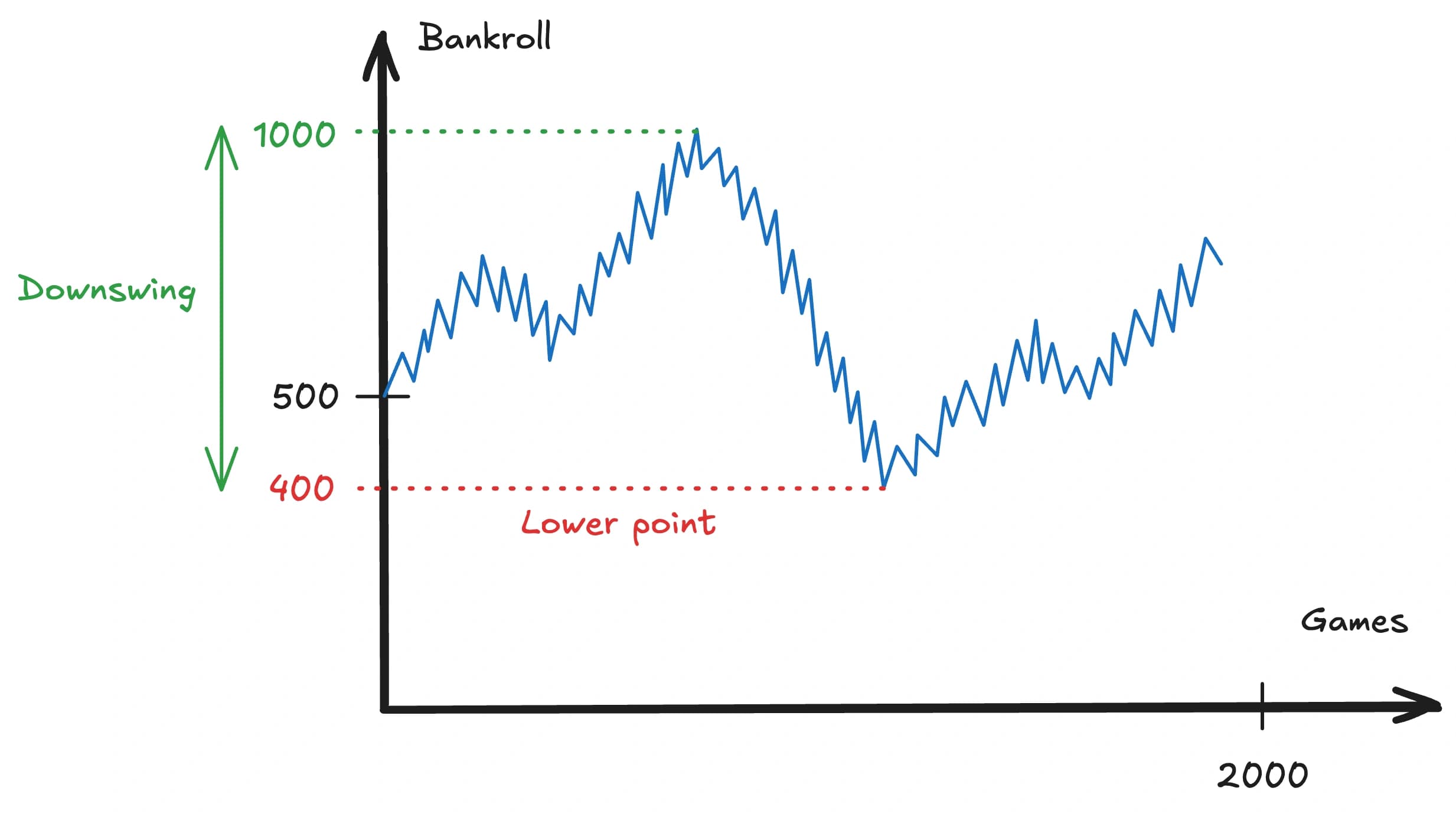
Lowest point (lower point)
This is the lowest level reached by the bankroll during a period. On the chart, it's the moment when the bankroll dropped to €400.
Downswing
This is the difference between the highest point and the lowest point of the bankroll during a given period. On the image, the bankroll went from €1,000 to €400, so a downswing of €600.
Simulation results for the lowest point
Here are the simulation results:

We can observe the following:
With a CEV of 59, there is a 50% chance of reaching a low point of -14 buy-ins (i.e., €472).
A 20% chance of dropping to -29 buy-ins (€442).
In the worst case, the bankroll can drop to €338 (-81 buy-ins).
Simulation results for the downswing
With Swongsim, we can also analyze the largest potential downswing. Still over 2,000 games:
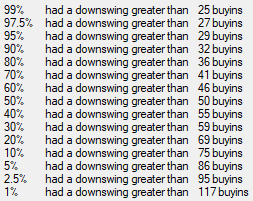
Observations:
An average player at €2 has a 50% chance of having a downswing of 50 buy-ins over 2,000 games.
There is a 30% chance of having a downswing of 60 buy-ins or more.
A bankroll increase followed by a drop of 60 buy-ins (e.g., €500 → €650 → €530) is therefore completely normal!
Conclusion: what bankroll for what level of safety?
The simulations show that an average player at €2 should have at least (approximately) 85 buy-ins to avoid being in danger (to avoid having a lowest point at €0...).
For safety, a starting bankroll of 100 buy-ins would therefore be a good foundation.
Your skill level also influences the recommendations. The weaker you are at the tables, the deeper a bankroll you'll need. Here's what we recommend:
- Beginner (CEV 45): 200 buy-ins recommended.
- Average player (CEV 59): 100 buy-ins minimum, 150 to play comfortably.
- Experienced player (CEV 70+): 70 buy-ins may be sufficient.
Please note, all these recommendations apply to classic Spin players, meaning games where all players start with 500 chips. For Spin Nitro, you will need a bankroll approximately 2 times larger, as the variance is much higher.
Note that a "good" CEV strongly depends on the stakes you play at. The higher the stakes, the harder it is to have a high CEV. A player with a CEV of 40 at €20 is probably better than a player with a CEV of 60 at €2.
In the previous chapter, we saw that a high volume of play was necessary to beat variance. We've now seen here that a starting bankroll of at least 100 buy-ins is equally necessary.

What to do if your bankroll gets close to 0?
Let's imagine that following our advice, you start playing Spins with a starting bankroll of 100 buy-ins.
But bad luck strikes, you start with a big downswing and your bankroll is already down to just 30 buy-ins...
What should you do in this situation? There are three options:
1. Grit your teeth...
Mathematically, according to the simulations, you're not supposed to reach 0. However, you may have overestimated your skill level (i.e., your CEV) and therefore the simulations might not correspond to your actual skill level.

2. Move down in stakes
This is probably the wisest option. The one we recommend if you feel you're no longer comfortable with your bankroll level. Move down in stakes, rebuild your bankroll a bit and regain confidence. Move back up when you feel ready to face variance again.
There's no shame in moving down in stakes if you no longer feel comfortable with your bankroll level. I've done it myself at times during the early stages of my Spin grinding journey.
3. Reinject money into your bankroll
Certainly the worst option. It has the same flaw as the first one: you think the downswing is only due to bad luck and will therefore stop, but in reality you're simply playing worse than you think.
You'll keep injecting money into your bankroll and poker will become a source of loss rather than income for you. In any case, the whole point of bankroll management is precisely to avoid having to reinject money into it!
Bonus: breakeven periods
Want more simulations? With Swongsim, you can also simulate breakeven periods, meaning periods during which you neither lose nor gain money. And spoiler alert, these periods can be long...
For example, here's a chart I created that shows a breakeven period spanning 1,700 games.

Let's now look at what the simulations show to see how frequent these periods can be (using our €2 player with a CEV of 59 as an example):

We can see that over 2,000 games:
You have a 50% chance of having a period of 700 games without generating any profit.
A 100% chance of having a period of 250 games without earning a single cent...
As you can see, breakeven periods, sometimes lengthy ones, are part of every winning player's journey.
In summary
Bankroll management is essential to secure your progression.
An average player should have 100 buy-ins minimum to start, or even 150 buy-ins to play comfortably.
Downswings and breakeven periods are normal: losing 60 buy-ins or not winning for 700 games is a common occurrence.