
Chapter 11: 3 basic strategies for Spins (beginner)
The chapter you were probably eagerly waiting for.

Gandalf
Professional Spin & Go player, co-founder of Poker Sciences

Don't worry, nothing too complicated.
The goal of this chapter is to give you three simple and immediately actionable strategies to start building a winning approach in Spins.
You'll notice that most of these concepts focus on preflop play. That's perfectly normal:
Preflop accounts for roughly 70% of the available EV in Spin & Go.
And we could add that this phase determines the next one, which is of course the postflop. Getting into trouble from the preflop doesn't bode well for the postflop.
And recreational players make their biggest mistakes at this stage.
You can therefore gain a massive edge over your opponents by minimizing your own preflop mistakes while exploiting theirs.
Since this course is aimed primarily at beginner Spin players, the strategies covered here are extremely basic. If you have even a little experience in this format, you likely won't learn anything new here.

If you're looking for a comprehensive tool to master preflop play in Spins with the most profitable advanced strategies, feel free to check out the Study Pack.
Strategy 1: Never limp on the Button (BTN) in 3-max
When you're on the Button (BTN) in 3-max, you should never limp. This is a common mistake among beginner players.
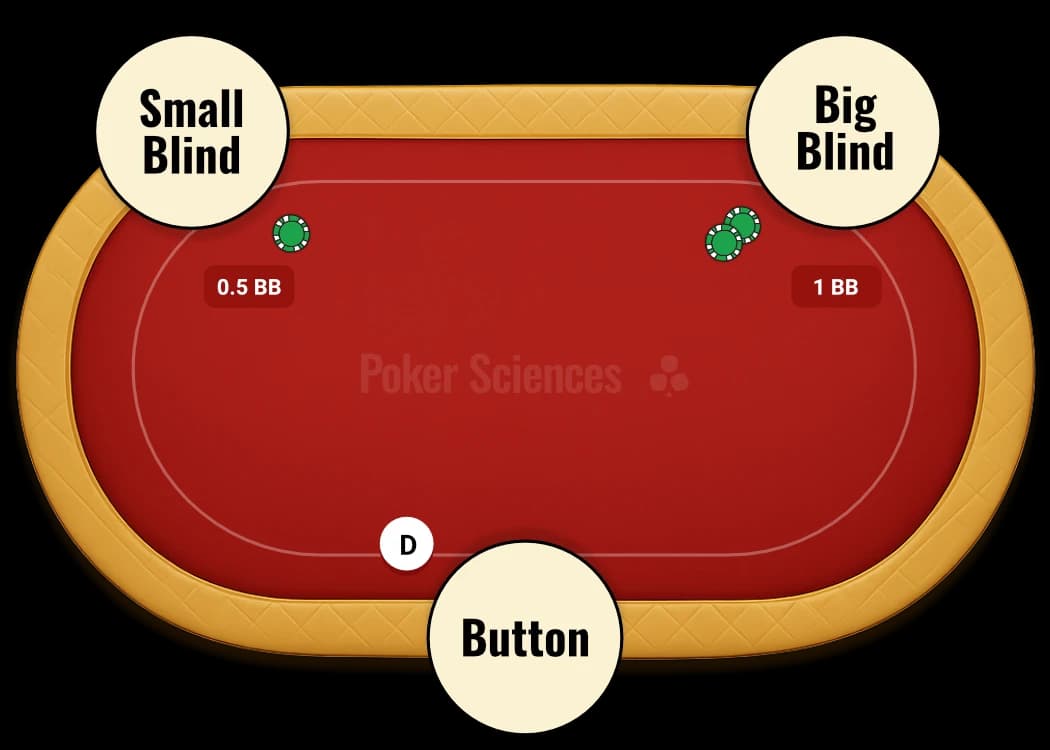
Your only viable options are:
- Min-raise with your best hands.
- Fold if your hand is too weak to be played.
- Open shove, which becomes interesting below 18 bb with certain hands.
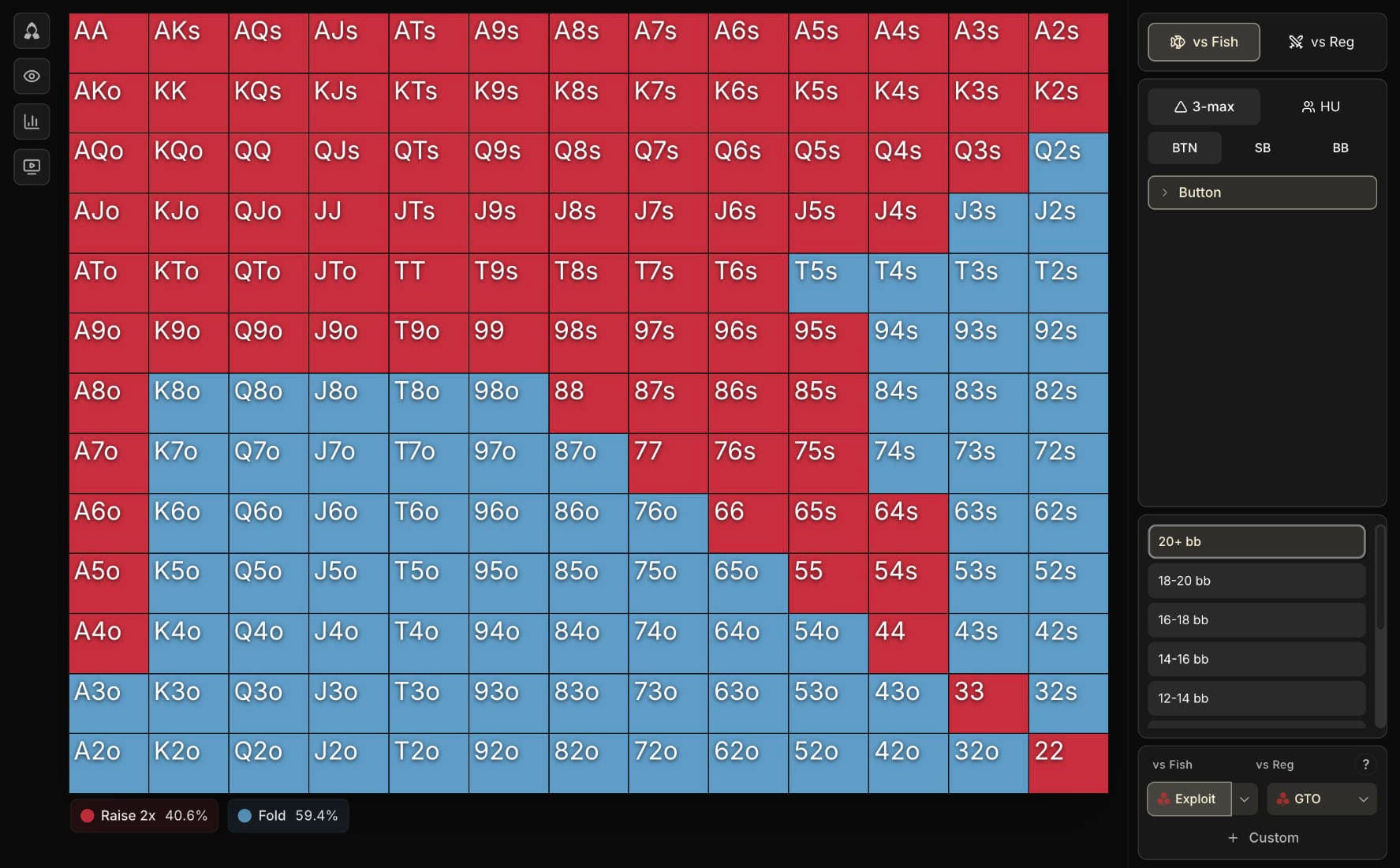
Why avoid limping in this spot?
Limping on the BTN doesn't put enough pressure on the blinds, and doesn't allow you to properly grow the pot with your best hands.
You give the Big Blind a free look at the flop, and the Small Blind an almost free flop, without them having to pay more.
Key takeaway: if you think your hand is too weak to raise, it's better to fold rather than limp.
Strategy 2: From the Small Blind in 3-max, play tighter than you think
The Small Blind is the hardest position to play in 3-max. Why?
You always play out of position against the BTN and against BB.
The BTN's opening range is generally quite strong, including hands like broadways, Ax, and mid pairs. These hands often dominate yours.
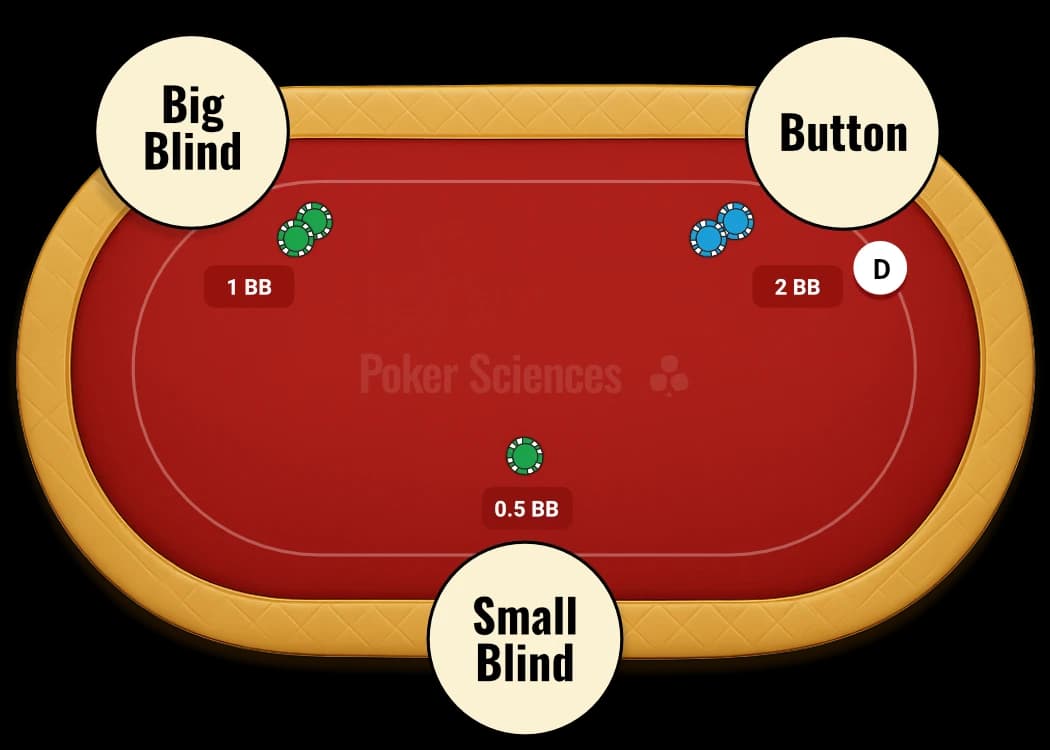
As a result, you need to play much tighter than you probably expect, and adopt an aggressive approach with your best hands.
Facing a BTN open (or limp), your strategy should be:
- Lots of 3-bet shoves (all-in).
- A few rare calls with hands that play well postflop.
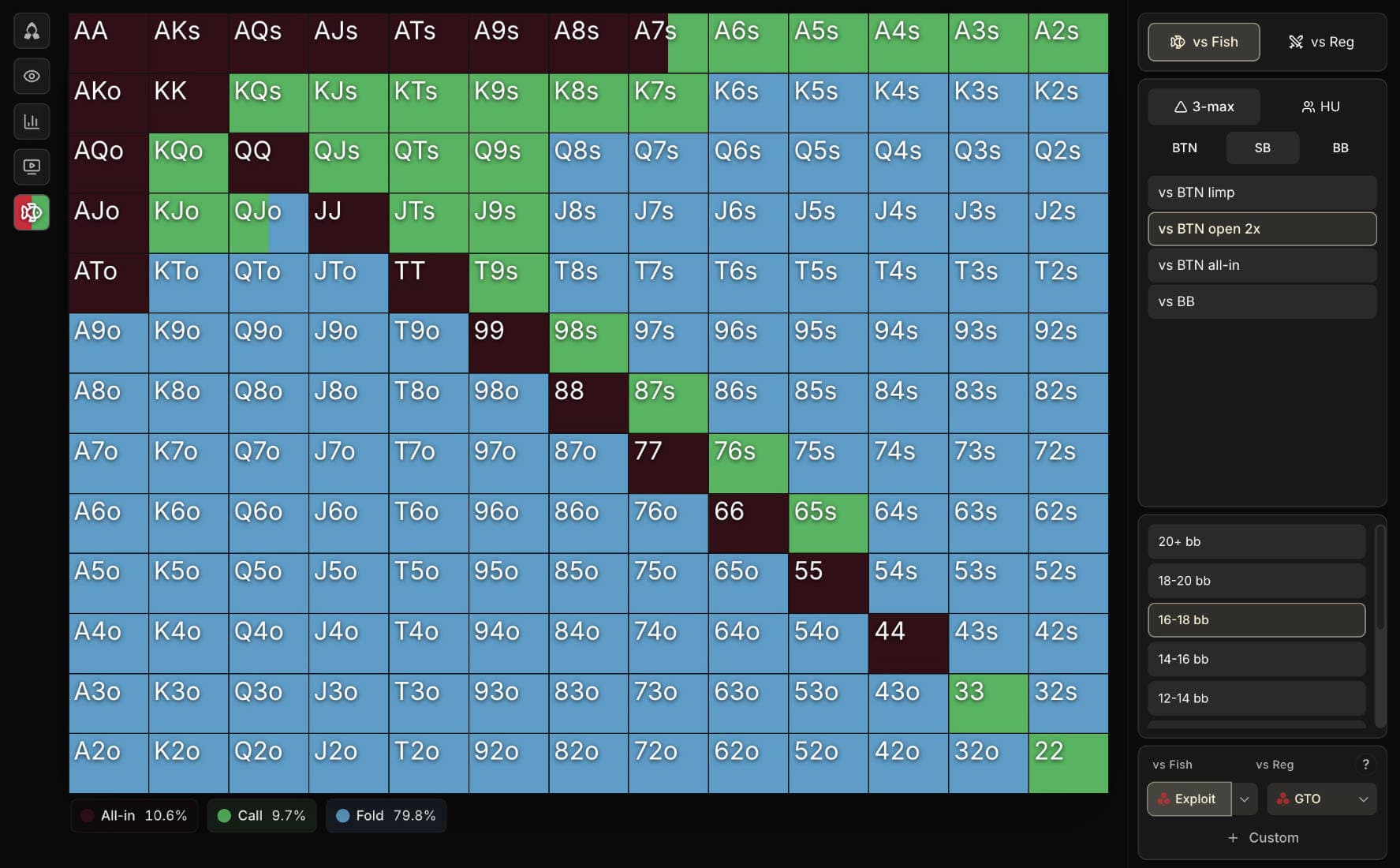
Why favor the 3-bet shove?
- It puts enormous pressure on the button, who will have to fold a large portion of their range.
- You avoid playing a pot out of position postflop.
- You maximize your fold equity and take advantage of recreational players' tendency to over-call with dominated hands.
Key takeaway: Defend very little from the SB. And generally prefer 3-bet shoving over calling.
Strategy 3: Adapt your calls facing open shoves
Most of your opponents will open shove too tight.
This means you shouldn't call too wide, contrary to theoretical "GTO" strategies (we'll revisit the GTO concept in chapter 13).
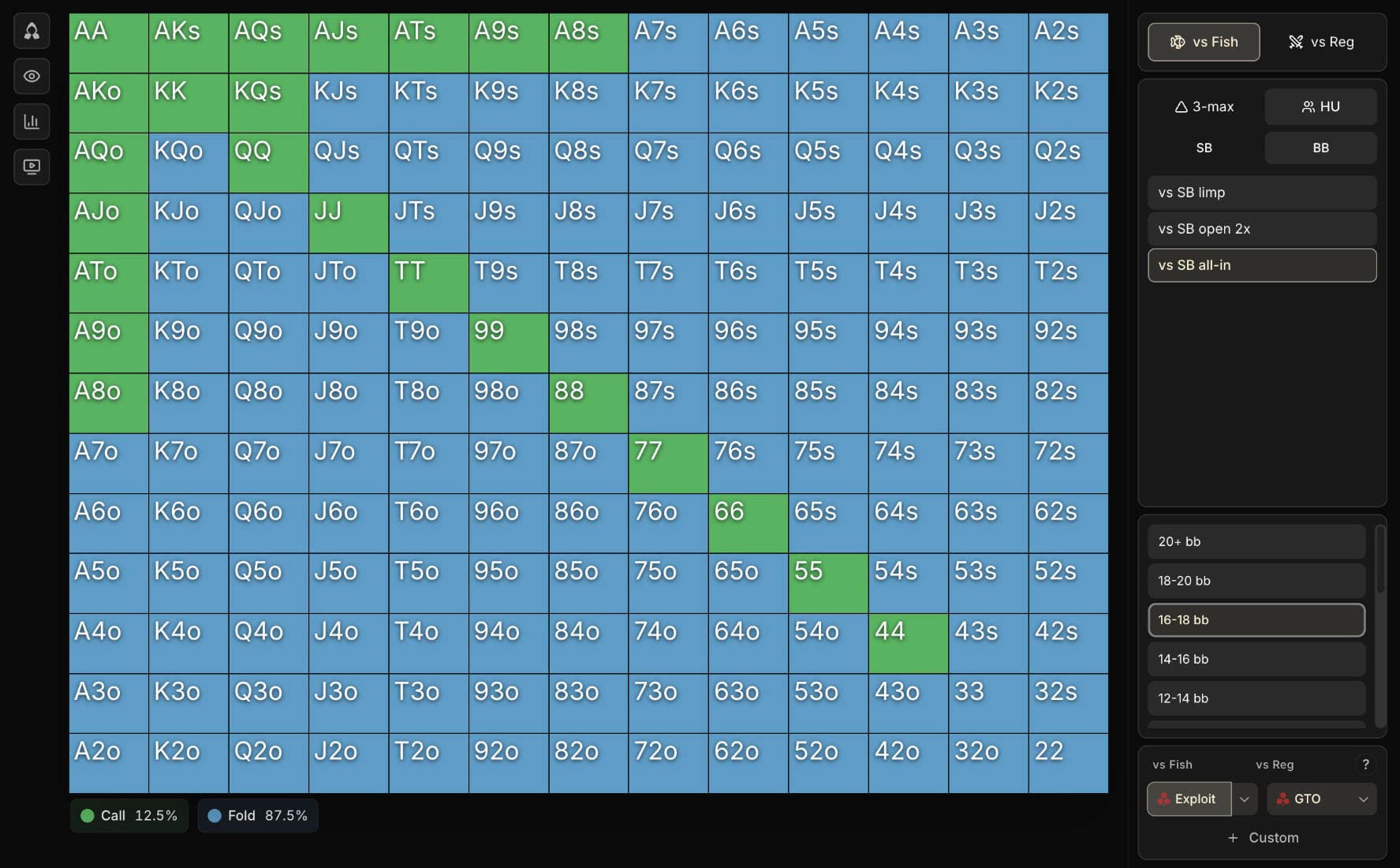
In BB in Heads-up (HU) facing an SB Open Shove 17 bb deep for example, prefer a conservative strategy by choosing to only call the top of your range:

Why adopt this approach?
Contrary to what many players think, the data shows that most recreational players facing you have an open-shove range that's too strong in this situation.
It's therefore better to increase our fold frequency and only call with the best hands.
Even if a call is slightly profitable (EV+), it's not always optimal. Against recreational players, we want to prolong the game and avoid overly risky confrontations that could eliminate us for a marginal EV gain.
The main goal is to preserve our stack, in order to capitalize on our opponent's future mistakes.
Caution: the lower the effective stack gets, the more you'll need to adjust your play and widen your calling ranges. It's essential to know which hands you should call or fold against a recreational player.
To help you, the table below (from the Study Pack) shows which hands to call depending on the number of blinds remaining against an open shove (all-in) from SB in Heads-up.
This table assumes that SB is a recreational player and therefore that we're applying an Exploitative strategy rather than GTO (more details on these concepts will be given in chapter 13):

How to read the chart?
Example: you should call an SB shove with Q7o starting from 6 bb, and starting from 5 bb for T5s.
Suited hands "s" (suited means both cards are of the same suit, e.g.: J♦️8♦️) are above the diagonal.
Offsuit hands "o" (offsuit means both cards are of different suits, e.g.: J♦️8♣️) are below the diagonal.
This chart is extremely valuable. Make sure to save it and refer to it regularly.
Key takeaway: recreational players shove too tight from BB in Heads-up. So be cautious when they do.
Summary
To summarize the three basic strategies covered in this chapter:
- Never limp on the BTN in 3-max. Raise or fold.
- Prefer 3-bet shoving from the SB rather than calling facing a button open.
- Be conservative with your calls against open shoves. Recreational players shove too tight, don't pay them off too wide.