
Chapter 13: Introduction to Advanced Strategies
It's time to introduce you to the two main families of strategies in modern poker: GTO play and Exploitative play.

Gandalf
Professional Spin & Go player, co-founder of Poker Sciences

The robot will symbolize GTO play and the devil Exploitative play.
Since the beginning of this course, we have mentioned two different ways of playing on several occasions, without really going into detail until now:
- GTO play (which we have also sometimes called "theoretical" play)
- Exploitative play
We will now look in detail at these two main families of strategies and how they can help us, depending on the situation, to take the most chips from our opponents.
GTO: The Unexploitable Strategy
GTO is a strategy that, when executed perfectly, cannot be beaten in the long run. Even if an opponent knows your exact game plan (in other words, even if you tell them "in this situation, I'll do this, and in that situation, I'll do that") they won't be able to take more chips from you in the long run than you take from them.
Why? Because GTO is based on a complex mathematical equilibrium that guarantees that no matter how your opponent reacts, they cannot exploit you.
A good example is rock-paper-scissors:
- If you always play "rock", you become predictable and beatable.
- But if you mix your choices unpredictably, your opponent can never gain an advantage over you.

Note that playing GTO in poker is still different because it allows you to beat your opponent for sure in the long run, not just break even like in the rock-paper-scissors example.
In poker, and particularly in Spin & Go, GTO works the same way:
- You are perfectly balanced between your bluffs and your strong hands.
- Your decisions are unexploitable in the long run. Even against the best players, you won't give them any opportunity to exploit your game.
- And most importantly: if your opponent doesn't play GTO perfectly (which is always the case in practice because playing perfect GTO is impossible for a human), you win chips from them on every hand.
To achieve this, the GTO strategy is based on a fundamental mathematical concept in game theory: Nash Equilibrium.

Nash Equilibrium and the Ice Cream Vendors Example

To better understand, imagine two ice cream vendors on a beach.
These two vendors will try to sell as many ice creams as possible.
We'll assume that customers will always go to the nearest vendor.
Each rectangle, blue or red, represents the beach area covered by each vendor.
If a customer is in the blue rectangle, they'll buy ice cream from the blue vendor. And conversely, if a customer is in the red rectangle, they'll buy from the red vendor.
Initially, they position themselves as follows. The red vendor attracts as many customers as the blue vendor, since each covers the same area.

But the red vendor gradually moves closer to the center to maximize sales. He notices that by moving closer to the center of the beach, he covers more area than his competitor.

To compensate, the blue vendor also moves, but to the right. Eventually, they both end up in the middle of the beach. At this point, neither can improve their situation. This is the famous Nash Equilibrium.

In GTO poker, it's the same thing: you play in a way that leaves no exploitable flaw for your opponents. Regardless of their strategy, you cannot be beaten in the long run.
Exploitative Play: The Adjusted and Aggressive Approach
Conversely, the exploitative strategy involves adapting your game to exploit your opponents' mistakes, even if it means being completely unbalanced.
Concrete example (exaggerated):
If a player folds every hand except AA, with which they always go all-in. GTO would continue to call some of these all-ins to remain balanced.
But clearly that's a bad idea! There's something far more profitable: an exploitative approach would fold 100% of the time facing this opponent's all-in, because there's no reason to call an all-in when you know the player always has AA.
The exploitative approach is very powerful against weak players. But it also comes with risks: if you play too exploitatively, a skilled player can in turn exploit you.
The Ice Cream Vendors Example (Exploitative Version)
Now imagine that one of the vendors (the red one) adopts a poor strategy and positions himself too far to the right.
The blue vendor can then abandon the Nash Equilibrium and move close to him to capture a larger share of the customers.

This is an exploitative strategy: he adapts to his opponent's mistake (who is too far right) to maximize his gains, rather than positioning himself perfectly in the center of the beach as GTO would.
But if the red vendor realizes this, he can readjust his position… and the blue vendor could then lose his advantage. Exploiting also means taking the risk of being exploited...

GTO vs Exploitative: Advantages and Disadvantages
Each strategy has its advantages and disadvantages. Let's make a summary table to see things more clearly:
| Strategy | Advantages | Limitations |
|---|---|---|
| Exploitative | Maximizes gains against weak or predictable players. | Can be counter-exploited if an opponent adapts. |
| GTO | Solid and unexploitable strategy in the long run. | Can underperform against weak players who make obvious mistakes. |
Should You Play GTO or Exploitative in Spin & Go?
Spin & Go is a format where opponents are very varied:
- You'll face many recreational players.
- But also some good regulars (depending on your stake).
The best approach is therefore hybrid:
- Master GTO for a solid and unexploitable game against good regular players.
- Learn to recognize and exploit opponent mistakes methodically.
The proportion of recreational players varies greatly depending on your stake. They are almost absent up to €2 before becoming more and more numerous as you move up in stakes.
To learn more, feel free to read our Bankroll Challenge.
This is precisely the approach adopted in the Study Pack ranges:
- Each preflop range is available in a GTO version (vs Reg), for balanced and unexploitable play against regular players.
- And in an Exploitative version (vs Fish), tailored to recreational players' mistakes.
You can compare both approaches, observe their differences, and understand the adjustments through the detailed explanations that accompany each chart.

Warning! Both Strategies Are Difficult to Master
Many players think they correctly exploit their opponents, when in reality they adapt based on sample sizes that are too small or make ineffective adjustments.
A poor reading of tendencies can quickly lead to bad decisions and make you lose money instead of making you win.
Classic example:
- You see an opponent fold twice against a 3-bet.
- You conclude they fold too much, and you start 3-bet bluffing much more.
- But in reality, they simply had two weak hands and will soon start defending correctly.
- Worse still, your new bluff frequency has become excessive and you are the one indirectly being exploited by your opponent.
This type of mistake is common: a hasty interpretation of tendencies leads to rushed and counter-productive adjustments. Even experienced players can regularly fall into the trap of false adaptation.

To effectively exploit an opponent, it's not enough to rely on intuition or a few recent hands.
The only reliable way to adapt is to rely on simulations run through solvers.
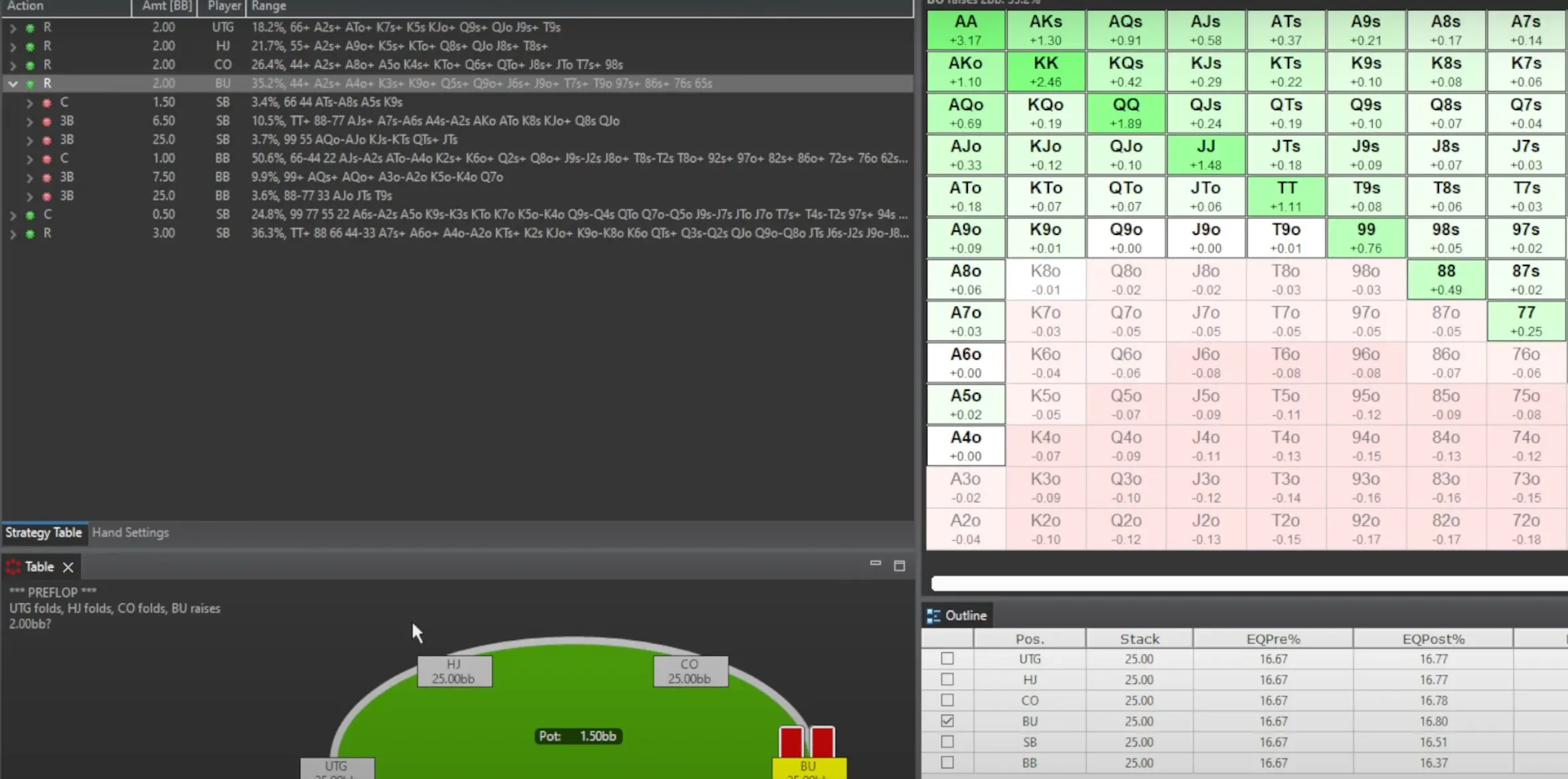
But these tools are not easy to learn and require databases of hundreds of thousands of hands to provide reliable results.
That's why we created the Study Pack: the goal is to provide an all-in-one tool, easy to use, that does the data analysis work for you and gives you the most profitable strategy for every preflop situation.
And these strategies are meticulously explained, situation by situation in Strategic Guides.
This Course Is Now Complete

Congratulations for making it to the end! I hope you enjoyed it.
What you've just read is the result of several months of work and years of grinding. I truly wanted to write the content I would have loved to have when I started playing Spins.
You're part of the minority of players who made it through this entire training. You've now acquired all the essential fundamentals to start progressing seriously and confidently in Spins.
So once again, congratulations and good luck at the tables!
Gandalf.
For any questions, comments, criticism, ideas, or anything else, feel free to contact me on our Discord or at support@pokerspintracker.com, I'll be happy to reply.