
CEV vs Fish concentration
Why choosing your tables properly is probably the biggest lever you have to earn more.

Gandalf
Co-founder of Poker Sciences

The fish / reg ratio of your field drives a large part of your results, often as much as your technical level.
It's also the most underrated lever in Spin.
And if you're already very solid, if your skill has hit a ceiling and you struggle to squeeze out more EV, there's an enormous amount to gain just by picking better moments to grind.
You now know how the tracker classifies opponents, where that information lives and how to measure the quality of your field.
This last chapter projects that impact onto your own history, breaks your CEV down into three factors, and closes the loop on the three pillars of the Spin player.

Your CEV curve by Fish/Reg
In the Stats tab of the Dashboard, pick the cEV & Profit Fish/Reg mode from the menu of the CEV card.
The curve projects your CEV as a function of the fish / reg ratio of the field.
It relies only on your Spins, split into three table profiles (Spin 2 fish, Spin 1 reg + 1 fish, Spin 2 regs), and works out what your CEV would be for any proportion of fish, from 0 to 100%, including the ones you've never come across.
Like the cEV by table profile card, it needs classified opponents: on GG Poker, where nicknames are anonymized in every tournament, it stays empty.
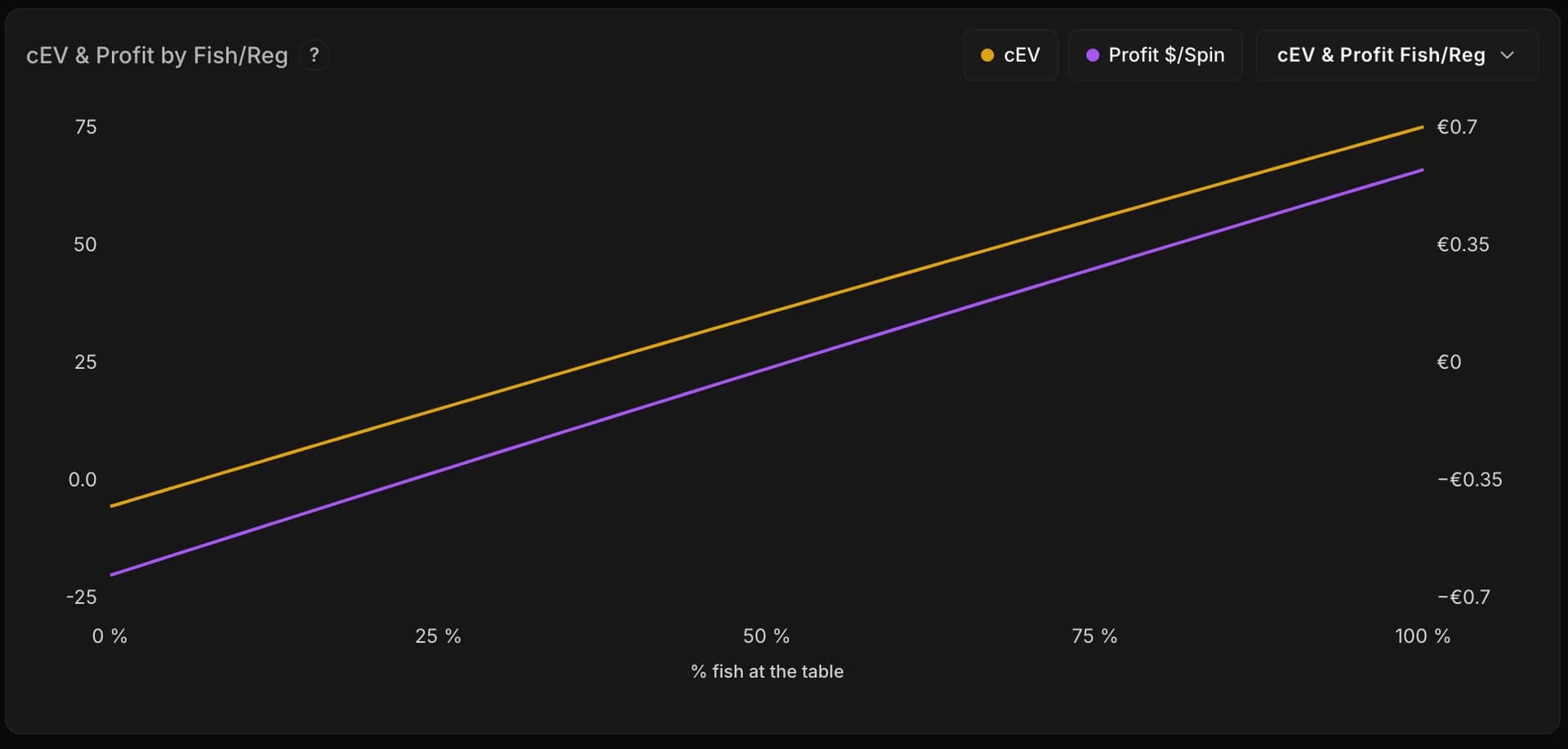
The yellow curve plots your CEV by % of fish in the field.
The purple curve turns that CEV into money won per Spin, rakeback included. It's not switched on by default: enable it by clicking Profit $/Spin, at the top right of the chart. In other words: what a slightly softer field is actually worth, in cash.
The high-stakes paradox
The higher you climb in stakes, the more your field fills up with regs, and the fewer fish it holds. But those are also the stakes where this curve is worth the most in cash.
At high buy-ins, gaining only a few percentage points of fish in your field can, on its own, double your winrate.
This curve is one of the most valuable stats in the tracker: it puts a cash-per-Spin figure on every effort you put into the quality of your tables.
Every Spin player knows that CEV drops as you move up in stakes. What few realize is that the same mechanism plays out inside a single stake, depending on the period, the promotions or the time slots.
If the real scale of this effect still sounds exaggerated to you, let's take the problem from the other end: statistically, your observed CEV splits into three factors that can be clearly identified.
Three factors that explain your CEV
These three shares are independent and additive: put end to end, they add up to exactly the CEV you read on your Dashboard.
| Factor | What it represents |
|---|---|
| Runs | The share of pure variance, down to luck and to the lack of volume over the period. |
| Fish | The share explained by the fish ratio of the field you came up against. |
| Skill | Everything that's left: the share that belongs to the player, independent of the field and of luck. |
Picture a player after 1,000 Spins. In the short term, variance dominates everything. But over time, the weight of each factor evolves in a very predictable way:
The Runs share
It disappears with volume. Variance smooths out mechanically Spin after Spin, and past a few tens of thousands of Spins it becomes negligible.
Time switches this factor off.
The Skill share
It hits a ceiling, and very fast. That's counter-intuitive, so let's look at it closely.
Skill, inside CEV, measures what you manage to draw from the field you are served. That covers two mechanisms:
- Limiting your own mistakes (what costs you). The more you improve, the fewer you make. And the more solid you become, the harder your opponents find it to exploit the ones that remain. That loss quickly tends toward zero.
- Exploiting your opponents' mistakes (what pays you). The fish ratio decides how many mistakes there are to pick up around you, that's Trap 2 of the chapter CEV: traps to avoid; your exploit skill decides how many you actually pick up. Early on, you improve fast on that. Then it hits a ceiling.
Working on your skill is endless, but its payoff in EV is finite. Past a certain level of mastery, the marginal gains become tiny.
The Fish share
It doesn't depend on you, but on the field sitting across from you. With 60% fish at your tables, you structurally earn more than at 30%, and that doesn't change with your level.
It's the only one of the three factors you settle by choosing your room, your buy-in and your time slot, not by working.
For a mature player (volume in place, skill stabilized), the fish ratio becomes the main and lasting engine of CEV. Choosing your tables gains more and more value as your level rises.
Back to the three pillars of the Spin player
This breakdown shines a direct light on the three pillars of the Spin player laid down at the very start of the journey. Each CEV factor matches a pillar, and therefore a precise lever to pull:
| Pillar | CEV factor | Lever to pull |
|---|---|---|
| Volume | Reduces the (bad) luck tied to variance | Play more Spins to multiply your earnings and smooth out variance. |
| Table quality | Raises the earning potential tied to your opponents' mistakes | Choose room, buy-ins and time slots to maximize the fish ratio. |
| Skill | The earnings tied to your level of play | Theory work, review, charts, postflop, trainer. |
Every player, as they progress, focuses on one pillar at a time.
At the start, it's often volume: playing enough for your numbers to mean something, and smoothing out variance.
Then comes the long skill phase, where there's a huge amount to learn and where progress in EV is the fastest.
Then, as skill stabilizes, skill and table quality start to overlap: you weigh working on your game against choosing where you sit down.
Finally, for an accomplished player, table quality becomes the most important pillar: it's the one that takes the least effort and changes their results the fastest.
To make lasting progress in Spin, you have to pull on all three levers at once: volume, table quality, skill.
Key takeaways
• In the Stats tab of the Dashboard, the cEV & Profit by Fish/Reg curve puts a cash-per-Spin value on every point of fish gained in your field.
• The higher you climb in stakes, the more this curve matters: a few % more fish can double your winrate.
• CEV breaks down into three factors: Runs (variance), Fish (quality of the field), Skill (your own ability). The Fish share often weighs as much as or more than skill, especially as you become competent.
• These three factors match the three pillars of the Spin player: Volume, Table quality, Skill. Seen at the very beginning of the Academy. We've come full circle...
This chapter closes Module 8, and with it the Academy.
You started out by learning to read your results. You leave knowing how to explain them: what you really earn, what comes down to luck, where you go wrong, and who you are playing against.
What's left to do comes down to just a few things, but they're the most important ones. Volume first, because nothing you have read here works on a three-hundred-Spin sample. The quality of your tables next, because it's one of the factors that count the most toward your earnings, and the one most often neglected: choose your rooms, your buy-ins and your time slots instead of putting up with them. Skill last, the one everybody talks about, but it only pays off in full once the other two are in place.
And above all, don't forget to enjoy yourself. Playing, and learning. Poker is an adventure, and that's the only way it deserves to be lived.
And of course, all along the way, come and join us on Discord to ask your questions. You are more than welcome.
Poker is a hard game, and there is no shortage of doubt, even for the most seasoned players. It's always good to surround yourself with a healthy, knowledgeable and positive community that will walk alongside you the whole way.
Poker may be a competitive game, and a zero-sum one at that, but helping one another is vital for every one of us. We have all, at one time or another, been the one full of doubt.
So congratulations again on making it all the way to the end, and good luck at the tables!
Gandalf.

To be continued...