
Results by profile
See your CEV at a glance depending on whether you play vs 0, 1 or 2 regs.

Gandalf
Co-founder of Poker Sciences

So far, you've been reading your overall CEV: a single number, aggregated across every table composition you've run into.
That's useful, but it hides one essential fact: your CEV is not the same against fish and against regs.
Breaking your CEV down by table profile means answering three precise questions:
- Am I winning as much as I should at tables with fish?
- Am I holding up well enough against regs, or am I losing too much?
- Where do my winnings come from? Only from tables with fish, or also, a little, from tables with regs?
Poker Spin Tracker lays out this breakdown in a dedicated Dashboard card.
The cEV by table profile card
Head to the Dashboard , Stats tab.
The cEV by table profile card there displays a bar chart comparing your average CEV across every table composition you've come up against.
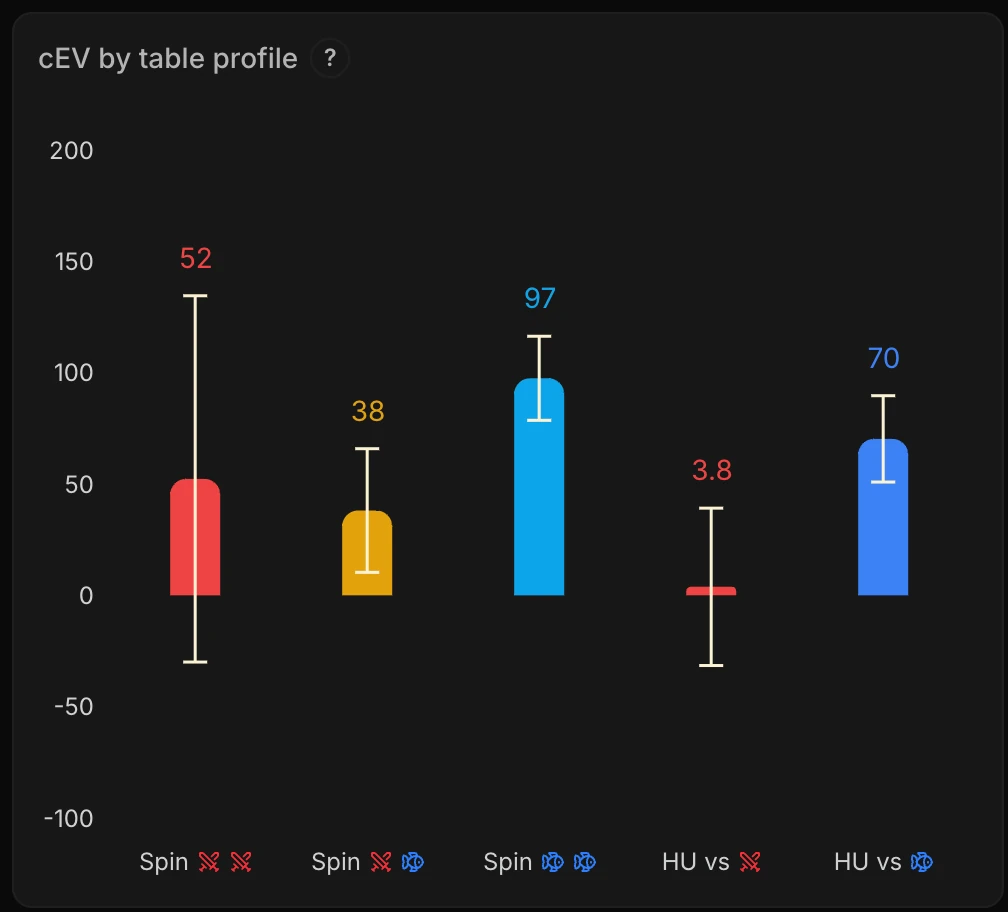
Each bar shows your average CEV on that profile, framed by a 90% confidence interval, exactly like on the Chips curve (CEV).
The shorter the error bar, the more Spin games you have on that profile and the more reliable the reading.
This card doesn't work on GG Poker. Nicknames there are anonymized in every tournament, so no opponent ever gets classified as fish or reg: with no table profile, there's nothing to compare and the card shows "Not enough data yet".
It's the same limitation as the one covered in the chapter Fish vs Reg.
The five profiles
The tracker distinguishes five possible compositions: three in 3-max (two opponents) and two in heads-up (a single opponent).
| Profile | On the chart | What it represents |
|---|---|---|
| Spin 2 regs | Spin | 3-max table where both of your opponents are classified as regs. CEV of the whole Spin, heads-up included |
| Spin 1 reg + 1 fish | Spin | Mixed 3-max table. CEV of the whole Spin, heads-up included |
| Spin 2 fish | Spin | 3-max table where both of your opponents are classified as fish. CEV of the whole Spin, heads-up included |
| HU vs reg | HU vs | Heads-up against a reg. CEV of the heads-up phase only |
| HU vs fish | HU vs | Heads-up against a fish. CEV of the heads-up phase only |
A HU vs … bar can never be compared with a Spin vs … bar: it only covers one phase of the tournament, whereas the other covers the whole game. It is mechanically lower.
In fact, the two bars often describe the same tournament: a Spin vs 2 fish that goes all the way to heads-up is counted in "Spin 2 fish" for the whole game, and in "HU vs fish" for its final phase.
How to read this chart
Four things to check when you open this card.
1. Check the natural order
Your CEV should decrease as the share of regs goes up:
If that order holds for you, your game is consistent.
If the order is reversed (a better CEV vs regs than vs fish), it most likely means you don't have enough data yet on one of the profiles.
Making more EV at less fishy tables is mechanically impossible in the long run.
2. Read it with the confidence interval
Before drawing any conclusion about a profile, always check how wide its interval is. The wider it gets, the less reliable the bar.
Some compositions are rarer than others: at small stakes, Spin vs 2 regs tables are few and far between, so that bar will often rest on very few games. Higher up in stakes, that happens less.
How to read the confidence interval is explained in detail in the chapter The Chips curve (CEV).
3. Compare your profiles across stakes
Open the Dashboard filters panel, Buy-ins section, and isolate one stake at a time (€2, €5, €10…).
Then watch how your CEV moves on each profile as the stake goes up. It is one of the most telling views you can get of your own game.
Three questions to ask yourself as you compare:
This comparison helps you pin down where you truly belong, and where your margin is shrinking.
Two players can have the same overall CEV and two problems that have nothing to do with each other:
4. A negative CEV vs regs is not an alarm
Don't over-interpret a negative CEV on "Spin vs 2 regs" or "HU vs reg": these are the toughest compositions, the ones where your opponents hand you the fewest mistakes to pick up.
It is normal and expected for these profiles to sit close to 0, or even go negative because of variance.
This reading comes straight from trap no. 2 of the chapter CEV: traps to avoid: CEV tends toward a finite limit, equal to the sum of your opponents' mistakes minus the sum of your own. Two regs at the table = very few mistakes handed to you = a mechanically low EV ceiling.
So the right question is not "am I winning vs 2 regs or in HU vs reg?", but "am I staying close to 0?".
A heavily negative CEV on these profiles, on the other hand, does deserve a real investigation.
Conversely, some very solid players manage to pull +10 to +12 CEV vs regs, particularly at €2 / €5 / €10 and sometimes up to €20. It's not out of reach, but it usually takes playing fewer tables at once.
It isn't a goal in itself: it's a lot of investment for a modest CEV gain, compared with what you can go and grab vs fish.