
Fish vs Reg: automatic classification
How the tracker automatically classifies your opponents, and why you can trust it.

Gandalf
Co-founder of Poker Sciences

We already touched on this at the very beginning, but the point deserves to be stated plainly: in poker, your EV comes mostly from your opponents' mistakes, and therefore from the fish.
Against regs, the skill gap is often small and what you can take from them stays limited.
Against fish, on the other hand, every hand is a chance to pick up extra chips that a serious player would never hand you.
This is a direct consequence of the second pillar of the Spin player, table quality, which we saw in the chapter The three pillars of the Spin player.
Your winrate therefore depends largely on this fish / reg ratio. But beyond the result, the way you play changes with the profile sitting across from you: you don't approach a hand the same way against a regular player as against a fish.
The tracker takes care of that sorting automatically, from your very first import. This chapter explains exactly how it classifies your opponents, and why you can trust it.

How the tracker classifies your opponents
The tracker automatically applies the following rule:
| Situation | Classification |
|---|---|
| Fewer than 50 hands played against the player | Fish by default |
| 50 hands or more, with a BTN limp above 5% | Fish |
| 50 hands or more, with a BTN limp of 5% or less | Reg |
Why wait for 50 hands?
Below that threshold, the tracker doesn't have a large enough sample to properly assess a player's profile. So it treats them as fish by default until more hands become available.
It's a cautious choice with no lasting consequence: if that player is in fact a reg, their classification will be corrected automatically once their history becomes representative.
Why use the BTN limp?
From 50 hands onwards, the tracker relies on the percentage of limps on the button in 3-max, in other words how often the player limps instead of open raising.
This statistic is a particularly strong discriminator in Spin. A reg very rarely limps at the BTN: the open raise is recommended by every range, and players who have studied theory even a little know it.
Fish, on the other hand, may limp to see a flop on the cheap, to avoid raising without a big hand, to try to trap with an Ace, or simply to copy what they see at their table. So the move shows up far more often among recreational players.
Outside anonymized rooms, there is no gray area: every opponent you run into falls into either the fish or the reg category.
One single exception: the rooms that anonymize all their players, like GG Poker. Nicknames there change in every tournament, which makes it impossible to follow an opponent from one game to the next. On those rooms, all your opponents belong to a third category: "Unknown".

A reg is a reg, a fish is a fish
The classification is global, per player. It doesn't depend on the room, on the buy-in, or on the time slot.
That choice is consistent with reality: a player's skill doesn't change because they move from a €1 on Winamax to a €25 on PokerStars. If they play cleanly at €1, they play cleanly at €25, and the other way round.
A reg is a reg. A fish is a fish. Their stats aggregate across all the hands you've played against them, all contexts taken together.
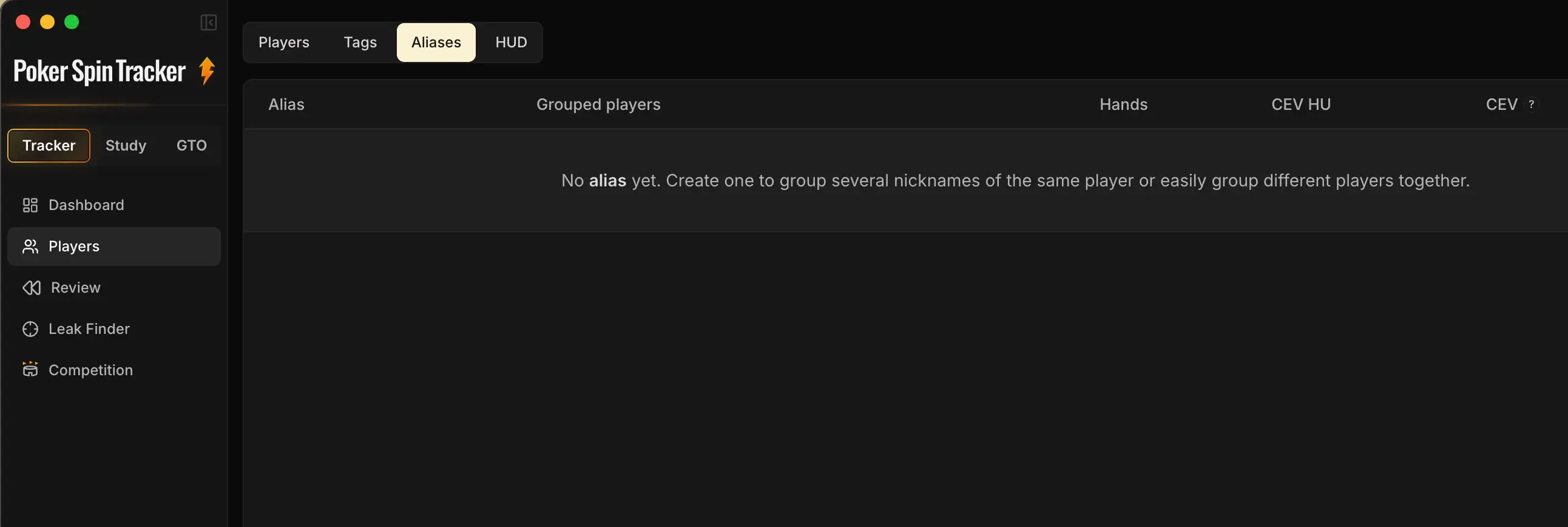
One important consequence: if your opponent plays under several nicknames (two different rooms, a nickname change), their stats only aggregate if you explicitly declare the link between those nicknames. That's what aliases are for, and we'll detail them in the next chapter.
Correcting the classification by hand
If a player's classification looks wrong to you, you can manually force a player to Reg or to Fish, everywhere their dots appear.
In practice, you'll almost never need to: you can trust the algorithm. Here's why:
- The algorithm has been tested at length on our own hand databases, and the results are solid.
- On the reg side, there are very few false positives: after 50 hands, a player who limps at the BTN less than 5% of the time is almost always a genuine reg. The rare "reg fish" land squarely in that category too: their limp frequency is comparable to a reg's.
- On the fish side, a few false positives are possible early on: a reg you've only just met is therefore treated as a fish before 50 hands. That's temporary: their classification is corrected as soon as their history becomes representative.
And this is the most important point: those temporary false fish have no lasting impact on your analyses.
As soon as a player flips to reg because their sample becomes representative, all your stats are recomputed retroactively: their past hands are reattached to the right category, and your winnings vs fish, your table quality and your CEV by profile are corrected automatically.
Over time, you'll find that this classification is more accurate than you would think at first. Plenty of players expect to have to correct it by hand, and end up giving that up because they realize it gets it right nearly every time.

Where you first see this classification
From your very first import, the import summary immediately shows you the result of this classification, in the form of the Table Quality card.
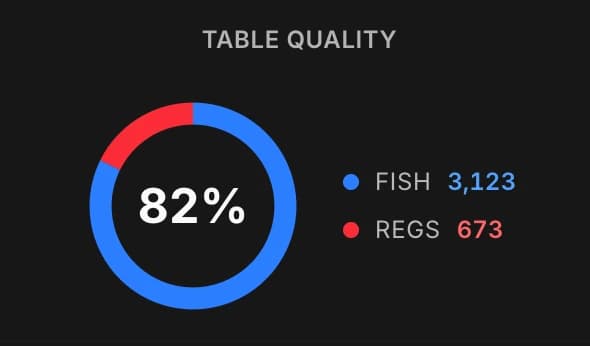
The donut gives you the share of fish and regs you faced across the whole import. It's your first direct read on the field mix you just played against.
Right below it, the panel also shows the breakdown by buy-in: one donut per stake played, giving you the fish / reg split stake by stake.
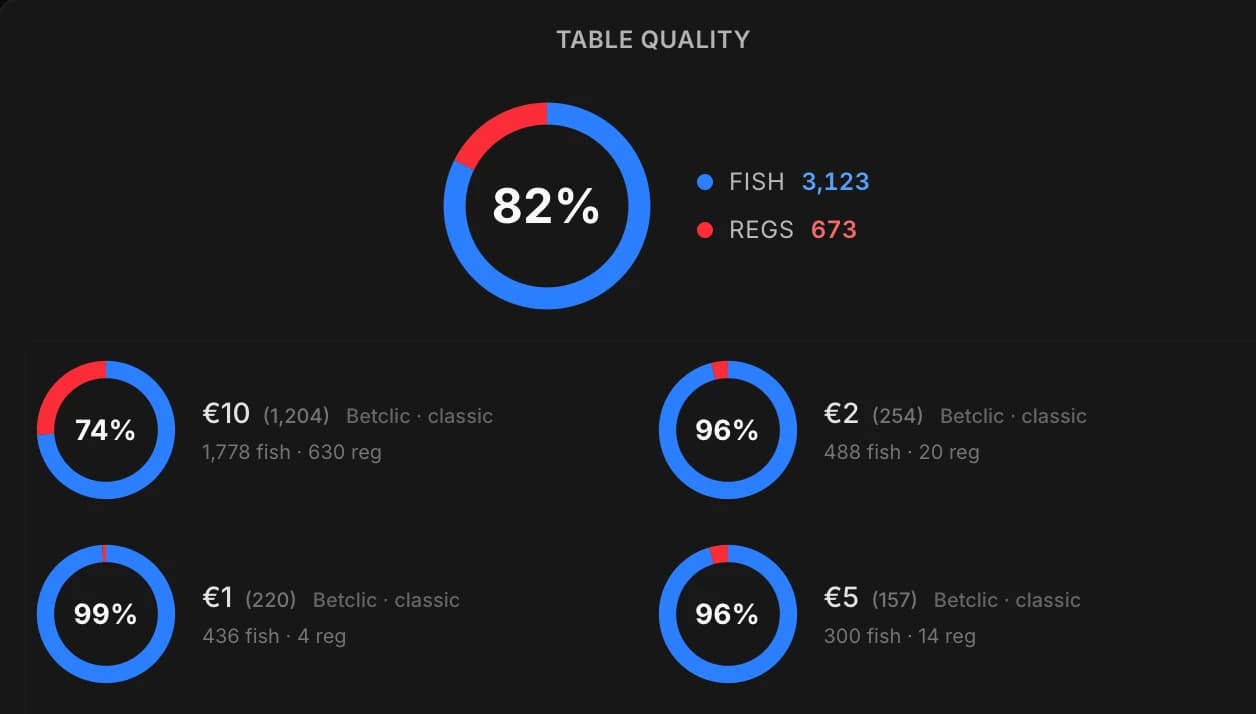
We will come back to this panel in depth, and to every surface that exposes field quality, in the chapter Table quality. For now, just remember that it exists, and that you'll find it again in the summary of every one of your imports.